
October 5, 2026
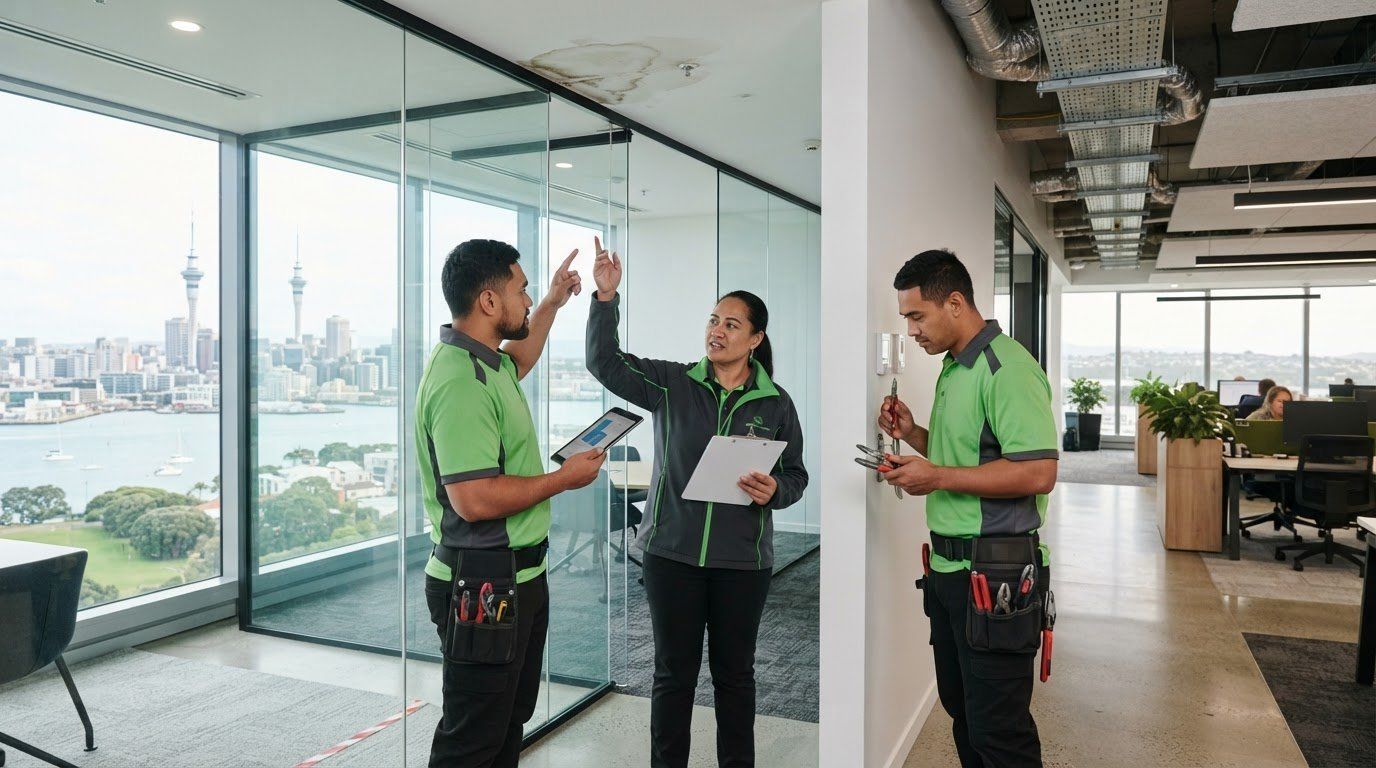
Could a ceiling stain be routine maintenance, accidental damage or a defect that’s allowing water in? For commercial property teams, building defect repairs commercial NZ sites need start by separating visible symptoms from underlying causes and setting clear priorities.
An issue may look minor but still worsen, affect occupants or disrupt daily operations. Acting without enough evidence can also result in an incomplete repair scope. Start by recording what you’ve seen, where it’s happening and whether it’s changing. Then assess the likely risk and decide what needs attention first.
This guide explains how to identify and document commercial building defects in New Zealand, distinguish them from damage or routine upkeep, and prioritise repairs based on safety, impact and urgency. It also covers what information helps define a practical repair scope, how to coordinate the work and what to record when it’s complete. A clear close-out and follow-up plan keeps the repair visible in your site maintenance records and helps inform future scheduled maintenance, including at Auckland properties.
Key Takeaways
- Assess the condition and context before classifying an issue as a defect, damage or routine maintenance.
- Record dated photos, the exact location, affected materials and any changes to support a clear assessment.
- Prioritise building defect repairs commercial NZ sites need by considering safety, deterioration, operational impact and repair dependencies.
- Agree the repair scope, coordinate access and work, then record inspection findings and close-out details.
- Use recurring issues and repair records to shape site-specific scheduled maintenance and future inspections.
Table of Contents
- What counts as a commercial building defect in New Zealand?
- How to inspect and document a suspected building defect in NZ
- How to prioritise commercial building defect repairs
- How to plan and verify commercial defect repairs in New Zealand
- How ongoing maintenance helps manage recurring building defects
What counts as a commercial building defect in New Zealand?
A commercial building defect is a fault, failure or performance issue that needs assessment because a building element may not be working as intended. It’s a reason to investigate, not a diagnosis based on appearance alone. A water stain, cracked finish or loose component can have different underlying causes. The visible symptom is useful evidence, but it doesn’t confirm the cause or the right repair.
Water ingress and recurring leaks need careful attention because the source may not be where the damage appears. New Zealand’s leaky homes crisis is a reminder that moisture problems can involve complex building issues. In a commercial property, an internal ceiling stain could relate to the roof, an exterior junction or plumbing. A suitable assessment helps establish what needs repair.
How to tell a defect from wear or routine maintenance
Compare the condition with the element’s intended function and any available maintenance, repair or building records. Note whether the issue is new, recurring, spreading or affecting normal use. A worn finish may need routine upkeep; accidental impact may have caused local damage; a repeated leak or a component that no longer works as intended may need further investigation. Age and appearance alone don’t prove a defect.
Context matters. A cracked finish in a low-use area may have a different operational impact from a crack near a busy entrance. Record what you can observe, and avoid assuming the cause before the issue has been assessed.
Which commercial building issues need prompt attention?
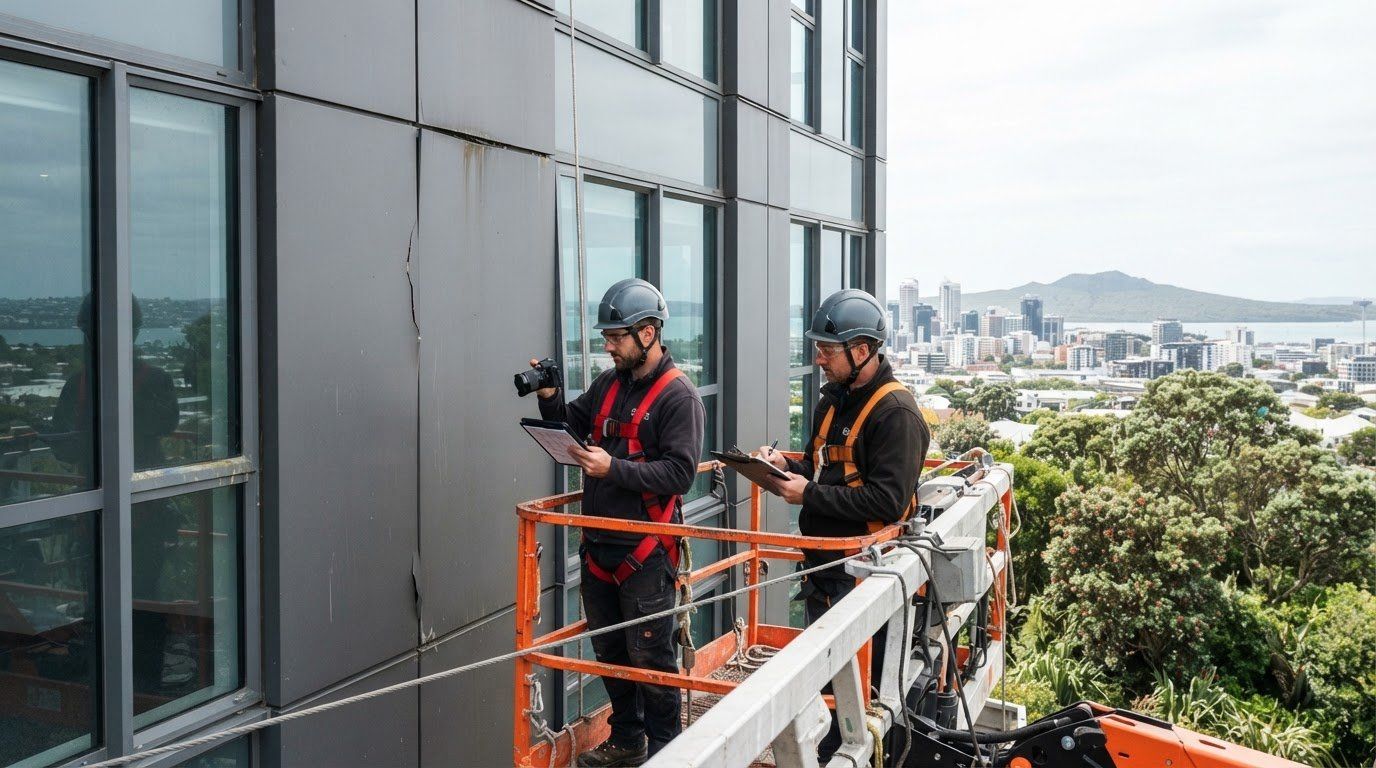
Respond promptly to signs of immediate danger, active water entry or loss of an essential building function. Put suitable controls in place for the affected area and arrange assessment based on the risk and site conditions. Suspected structural or life-safety concerns need assessment by an appropriately qualified professional.
Capture the details while they’re clear. Record the affected area, who or what may be impacted, relevant weather conditions and any effect on building operations. A leak that returns after a previous repair, a loose component above a walkway or water reaching an operational space each warrants attention. The response depends on the conditions on site.
This gives building defect repairs commercial NZ sites need a sound starting point: identify what’s known, record what has changed and separate urgent controls from decisions about the permanent repair. A clear assessment reduces guesswork and helps define the next step.
How to inspect and document a suspected building defect in NZ
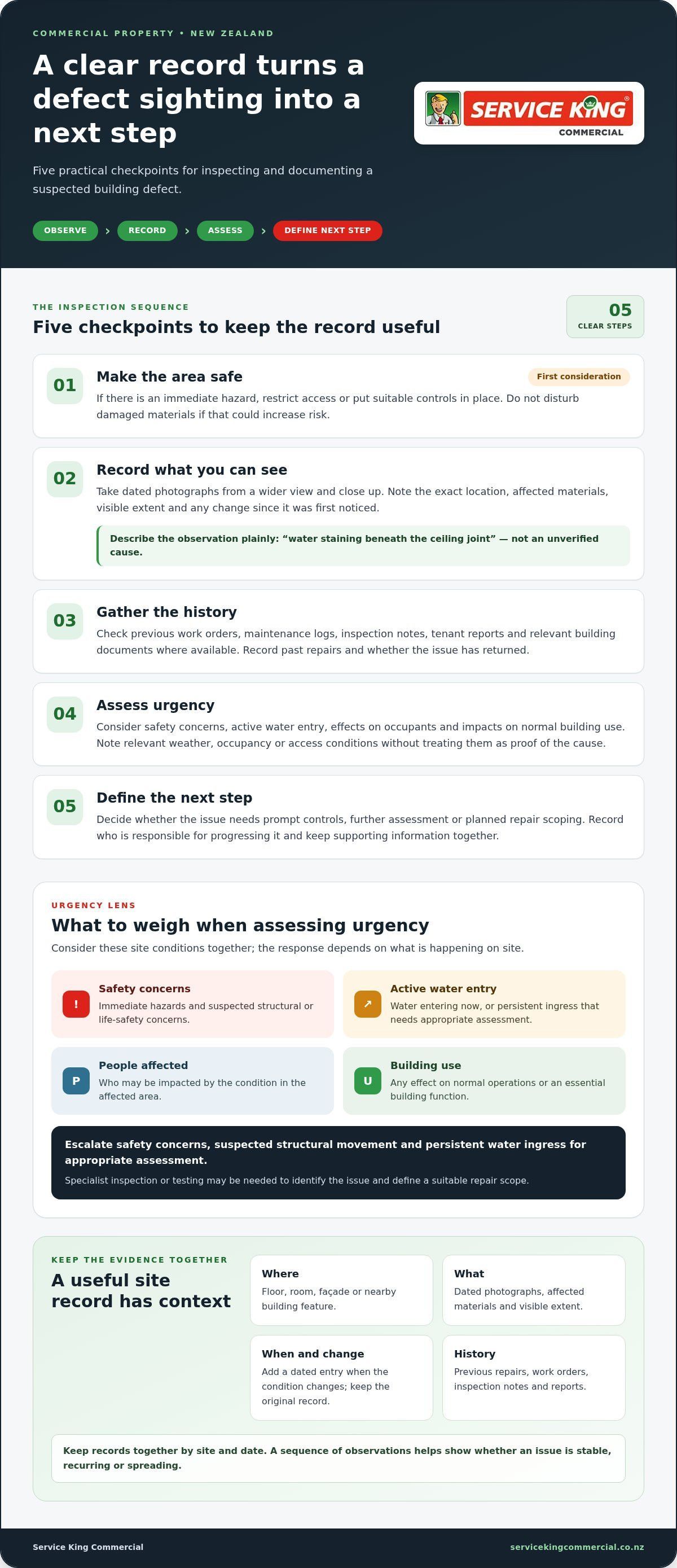
A consistent site record turns an initial observation into a clear next step and gives repair teams useful context when defining the work. Use this sequence for building defect repairs commercial NZ properties need, keeping the record factual. An initial inspection supports assessment, but it doesn’t replace a technical diagnosis.
- Make the area safe. If there’s an immediate hazard, restrict access or put suitable controls in place. Don’t disturb damaged materials if doing so could increase risk.
- Record what you can see. Take dated photographs from a wider view and close up. Note the exact location, affected materials, visible extent and any change since the issue was first noticed. Describe observations plainly, such as “water staining beneath the ceiling joint”, rather than stating an unverified cause.
- Gather the history. Check previous work orders, maintenance logs, inspection notes, tenant reports and relevant building documents where available. Record past repairs and whether the issue has returned.
- Assess urgency. Consider safety concerns, active water entry, effects on occupants and impacts on normal building use. Note relevant weather, occupancy or access conditions without treating them as proof of the cause.
- Define the next step. Decide whether the issue needs prompt controls, further assessment or planned repair scoping. Record who is responsible for progressing it and keep the supporting information together.
What evidence helps explain a defect?
Keep photographs, work orders, inspection notes and reports together by site and date. Make the location easy to find by noting the floor, room, façade or nearby building feature. If the condition changes, add a dated entry rather than replacing the original record. This creates a useful sequence for assessment and helps show whether the issue is stable, recurring or spreading.
Building documents can provide context for an element’s intended function. For general reference, Building Performance explains Building Code compliance in New Zealand. Check applicable compliance, consent or reporting requirements against current official guidance for the specific work. Don’t infer a requirement from an initial site observation.
When should a qualified assessment be escalated?
Escalate safety concerns, suspected structural movement and persistent water ingress for appropriate assessment. Specialist inspection or testing may be needed to identify the issue and define a suitable repair scope. Keep the record available so the assessment can take account of what has happened, where the issue is visible and what work has already been completed.
Once the findings support a defined repair scope, coordinated commercial building repair and maintenance can help move the work from assessment to completion.
How to prioritise commercial building defect repairs
Set repair priorities by comparing potential harm, how quickly the condition is changing and what the affected area supports. There’s no reliable one-size-fits-all score. A leak in an occupied workspace, for example, may need a different response from a similar issue in a closed storage area. Base decisions on site conditions and record why each item is ranked as it is.
| Factor | What to consider | How it affects priority |
|---|---|---|
| Safety risk | Could the condition harm occupants, visitors or workers? | Address immediate hazards first. Put suitable controls in place while repair work is planned. |
| Active deterioration | Is damage continuing, spreading or allowing water to enter? | Conditions that are worsening may need prompt attention to limit further impact. |
| Operational impact | Does the issue affect access, occupied areas or an essential building function? | Consider the effect on normal operations and whether part of the site needs to be restricted. |
| Repair dependencies | Does work rely on access, diagnosis, another trade or an earlier task? | Plan the sequence so prerequisite work and site access don’t delay the appropriate repair. |
Which defects should be dealt with first?
Immediate hazards and active damage generally take precedence over lower-impact cosmetic issues. Consider whether a defect affects a route through the building, disrupts business activity or could affect another building system. Separate temporary controls, such as restricting access to an affected area, from the permanent repair decision. Revisit the order if the condition changes, new information emerges or site operations are affected.
Record the reason for each priority. This helps property teams explain decisions, track outstanding work and adjust plans as conditions change. Building defect repairs commercial NZ properties need should reflect actual risk and operational needs, not an arbitrary ranking applied across every site.
How should the repair scope compare possible approaches?
Compare immediate risk controls with the planned repair that addresses the assessed issue. A temporary measure may reduce exposure or disruption, but it isn’t the same as completing the repair. Where the diagnosis affects the options, use appropriate technical advice before agreeing the scope.
Include affected locations, access arrangements, occupancy considerations, work sequencing and completion checks in the scope. On an occupied commercial site, coordinating trade tasks and timing can help manage disruption and keep dependent work in the right order. Record the agreed approach and why it was selected, then check the completed work against the scope.
How to plan and verify commercial defect repairs in New Zealand
Once the issue has been assessed and the scope agreed, plan the work around the building and the people using it. Clear responsibilities, access arrangements and completion checks help take building defect repairs commercial NZ sites need from an agreed scope through to recorded close-out.
What should a commercial repair plan record?
Keep the plan specific to the defect and site. Record:
- Location and scope: identify the affected area and describe the agreed repair work, including any limits to the scope.
- Access and occupancy: note how work areas will be reached, any access restrictions and how affected occupants will be informed.
- Safety controls and sequence: record relevant controls, the order of tasks and any dependencies between trades.
- Responsibilities: identify the work parties responsible for each task and who will coordinate site communication.
- Completion evidence: specify any inspections, photographs, reports or professional sign-off established for the project.
For an occupied Auckland office or retail site, the plan may need to account for customer routes, staff access and areas that must remain operational. Set out timing and work boundaries clearly so site teams know what to expect. Tailor the sequence to the building’s operational requirements.
Building Act, Building Code and consent implications depend on the specific work and circumstances. Verify what applies to the project using current official guidance and appropriate professional advice. Don’t assume every repair has the same documentation or sign-off requirements.
How do you confirm the repair is complete?
Check the finished work against the agreed scope. Record any outstanding items and who will action them. Take dated completion photographs where useful, and file relevant inspection notes, reports and trade documentation with the site records. This creates a clear history of what was done and observed at close-out.
Verification should suit the repair. It may involve a visual check, reviewing relevant documentation or another check defined in the project scope. If the original condition could recur or needs to be observed over time, set a practical follow-up check and record when it is due. Close-out is more than marking a work order complete. It confirms the agreed work has been reviewed and leaves a usable record for future maintenance.
For coordinated commercial building repairs and trade work, plan your commercial repair work with Service King Commercial.
How ongoing maintenance helps manage recurring building defects
A completed repair can provide useful information for the next maintenance plan. Track recurring locations, reported symptoms, work completed and follow-up observations. This can help a property team spot repeat patterns and decide whether inspection tasks or maintenance arrangements need review. It won’t prevent every defect, but it gives future decisions a clearer, site-specific basis.
How to use repair records to reduce repeat issues
Keep repair and inspection records together for each property. Note the affected building element, when the issue was reported, what work was completed and whether it returned. If a similar issue appears elsewhere, record that location too. Over time, these details can help identify areas that may need closer observation or a revised maintenance task.
Use the pattern to review inspection frequency and the upkeep suited to that property. Don’t assume the same interval will suit every building. An Auckland commercial site and a property elsewhere in New Zealand may differ in exposure, materials, use and maintenance history. Where the right response depends on technical diagnosis, use appropriate professional advice.
For recurring exterior issues, review the site’s condition and upkeep needs alongside Auckland commercial exterior building maintenance. Service King Commercial provides exterior building maintenance to help care for commercial property exteriors. Use repair records to guide what needs attention at your site.
When to move from a one-off repair to planned upkeep
Consider a scheduled approach when similar defects recur or several building elements need attention. Rather than treating each report in isolation, group related observations and use them to plan practical site checks and maintenance tasks. This is particularly useful where access, occupancy or trade sequencing affects how work can be organised.
Building defect repairs commercial NZ property teams coordinate can feed directly into this process. Use the repair history to set site-specific priorities, then adjust the plan as conditions change or new observations arise. Scheduled maintenance supports ongoing building upkeep, but it can’t guarantee against future damage or failure.
Service King Commercial provides scheduled maintenance and building repair services for commercial properties. If recurring issues are adding to your workload, discuss a site-specific maintenance and repair plan.
Put a clear repair process in place
Effective building defect repairs commercial NZ properties need start with evidence, not assumptions. Record what’s visible, consider safety and operational impact, then prioritise work based on conditions at your site. An agreed scope, coordinated access and recorded completion checks help keep repairs organised from first assessment to close-out.
Repair records also have value beyond a single job. Recurring issues and inspection findings can inform scheduled maintenance tailored to the property, helping teams plan practical upkeep and follow-up.
Service King Commercial provides commercial building repairs and maintenance for business premises, alongside scheduled maintenance shaped around site requirements. Arrange commercial building repair support with Service King Commercial to plan the next steps for your site. A clear, well-documented process gives your team a practical path forward.
Frequently Asked Questions
What is a building defect in a commercial property?
A building defect is a fault, failure or performance issue that needs assessment because an element may not be working as intended. Examples include recurring leaks, water ingress, cracked finishes or loose components. Appearance alone doesn’t confirm a defect or explain its cause. Compare the condition with the element’s function and available records, and consider whether it’s new, recurring or affecting normal use of the property.
How do I report a defect in a commercial building in New Zealand?
Report it promptly to the person responsible for managing the building or site, using the established property reporting process. Include the exact location, date, a concise description and dated photographs if safe to take. Note changes, affected areas, any operational impact and relevant weather or occupancy context. Keep a copy of the report and any response with the site’s work orders or maintenance records. Auckland sites can use the same clear record-keeping approach.
Which commercial building defects need urgent attention?
Prioritise conditions that present an immediate safety concern, involve active water entry or affect an essential building function. Examples might include a loose component above a busy route or water affecting an operational area. Restrict access or put suitable controls in place where needed, then arrange appropriate assessment. Suspected structural movement or life-safety concerns should be escalated to an appropriately qualified professional. Urgency depends on the defect and site conditions.
Can a building defect be repaired without fixing its underlying cause?
A repair may address a visible symptom without resolving the cause, so it may not be a lasting solution. For example, covering a stain won’t establish why water appeared there. First document the condition and arrange suitable assessment to understand what the repair needs to address. Temporary controls can help manage risk, but record them separately from the planned repair. Check completed work against the agreed scope and note any follow-up observations.
Do commercial building defect repairs in NZ require consent?
Consent requirements depend on the proposed work and the circumstances of the building. Don’t assume every repair requires consent, or that none does. Before work proceeds, establish whether the Building Act, Building Code or consent requirements apply to that specific project. Use current official guidance and appropriate professional advice where needed, particularly for complex or structural work. Record any project-specific inspection or documentation requirements as part of the agreed repair plan.
How can I prevent the same commercial building defect from recurring?
You can’t guarantee that every defect will be prevented, but good records help manage repeat issues. Track the location, symptoms, repair work and follow-up observations. Use patterns to review inspection tasks and maintenance timing for that property. For Auckland commercial premises, consider how the site’s use, condition and exposure affect upkeep. Service King Commercial’s scheduled maintenance is tailored to commercial site requirements and can help organise ongoing building care alongside repairs.
Recent Posts