
November 23, 2026
A tougher-looking finish isn’t always the best choice for a commercial slab. The right approach to commercial concrete sealing Auckland projects depends on the concrete’s condition, how the space is used and how much disruption the site can manage.
Before work starts, clarify the preparation method, moisture requirements, expected finish, traffic demands and ongoing care. Product claims alone won’t show whether a coating or penetrating treatment suits the slab. A useful scope explains what the treatment is intended to do and how the site will operate while the work is under way.
This guide compares common sealing approaches and sets out practical checks for planning a project around site operations. It also explains how to coordinate floor work with wider Auckland property maintenance. Service King’s Integrated Facility & Maintenance Service brings building repair and maintenance, exterior building maintenance and scheduled maintenance into a coordinated facility plan.
Key Takeaways
- For commercial concrete sealing Auckland projects, match the treatment to the slab’s condition, intended finish and site use.
- Compare grind-and-seal with penetrating treatments by their purpose, surface finish and maintenance needs.
- Plan work areas, pedestrian routes and access arrangements before preparation begins to help manage disruption.
- Coordinate floor-project planning with wider upkeep, including Service King’s building repair and maintenance and Scheduled Maintenance services.
Table of Contents
What commercial concrete sealing does for Auckland properties
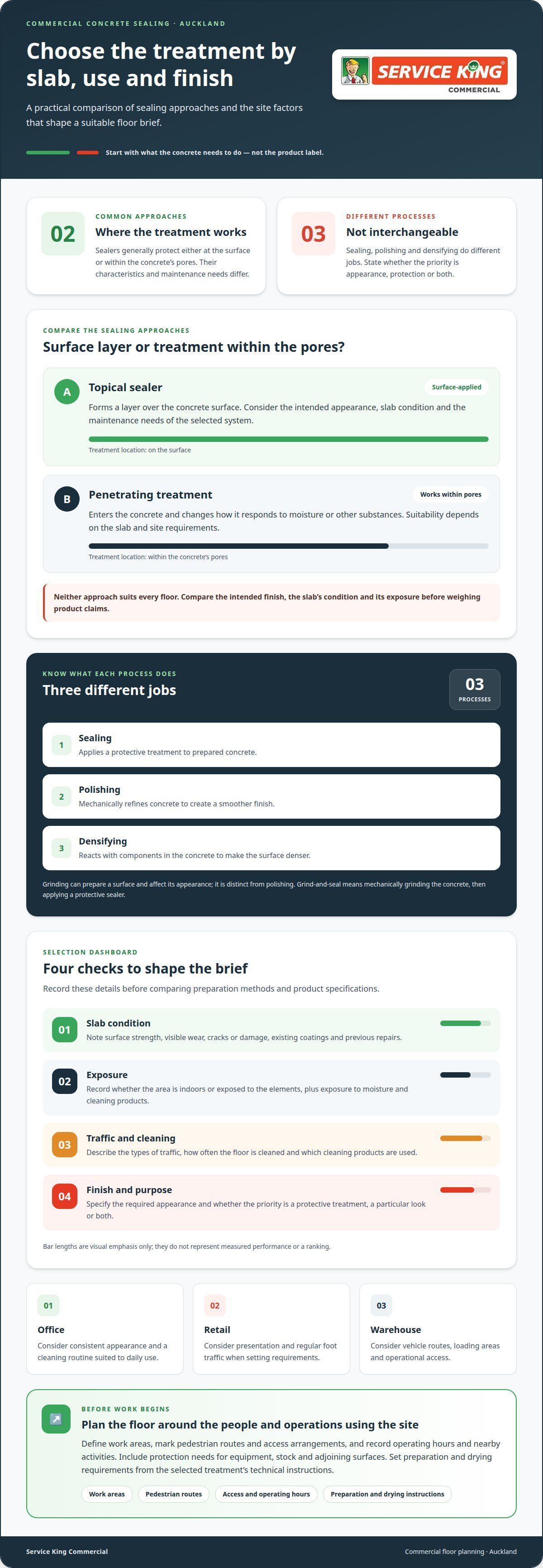
Concrete sealing applies a protective treatment to a prepared concrete surface. For commercial concrete sealing Auckland projects, the appropriate treatment and expected finish depend on the slab’s condition, the intended use of the space and the site’s requirements.
Sealers generally work either on the surface or within the concrete’s pores. A topical sealer forms a layer over the surface, whilst a penetrating treatment enters the concrete and changes how it responds to moisture or other substances. These approaches have different characteristics and maintenance needs. This overview of topical and penetrating concrete sealers explains the main categories.
Sealing is not the same as polishing or densifying. Polishing mechanically refines concrete to create a smoother finish. A densifier reacts with components in the concrete to make the surface denser. These processes can be part of a floor treatment, but they do not perform identical jobs. In the project brief, state whether the priority is a particular appearance, a protective treatment or both.
Where sealed concrete can fit in a commercial property
Offices, retail spaces and warehouses place different demands on a floor. An office may prioritise a consistent appearance and a cleaning routine that suits daily use. A retail space may need a finish that supports presentation and regular foot traffic. A warehouse brief may focus on vehicle routes, loading areas and operational access. Treat these as planning considerations, not as a guarantee that a particular sealing system will suit the site.
Start by recording how each area is used, how often it is cleaned and what finish is required. Note existing coatings, visible wear and surface damage. A treatment that suits a low-traffic office area may not suit a busy warehouse aisle. Documenting the differences helps define the work area and the performance expectations before a system is selected. If the floor has existing coatings or repairs, include their location and condition in the project notes.
Grind-and-seal or penetrating treatment: how Auckland sites can compare options
Start with the slab and the job it needs to do, not a product label. A surface-applied coating forms a layer over the concrete, while a penetrating treatment works within its pores. Neither approach suits every floor. For commercial concrete sealing Auckland projects, compare the intended finish, the slab’s condition and the site’s exposure before weighing product claims.
Grind-and-seal means mechanically grinding the concrete, then applying a protective sealer. Grinding can prepare the surface and affect its appearance, but it is distinct from polishing, which refines concrete to create a polished finish. Densifying is also a separate process. These methods may be considered alongside sealing, but they are not interchangeable.
What changes the choice of concrete sealer?
Assess the surface strength and note existing wear, coatings or repairs. Then consider exposure to moisture, cleaning products and traffic, along with the required appearance. A warehouse floor, for example, may have different demands from an indoor showroom. Epoxy, polyurethane and penetrating treatments have different properties, so don’t assume they perform the same way. Use the selected product’s technical information and the condition of the slab to set expectations for resistance, finish and maintenance.
It helps to make the requirements specific. Record whether the surface is indoors or exposed to the elements, what types of traffic use it and which cleaning products are part of the site routine. Note any areas where the required finish may differ, such as loading zones and pedestrian spaces. This information gives the project team a clearer basis for comparing product specifications and surface preparation methods.
When is grind-and-seal considered?
Grind-and-seal may suit a brief that calls for a mechanically prepared surface followed by a sealer coat. Offices, retail areas and warehouse spaces are useful contexts for setting requirements, not proof that one system is suitable. The slab’s soundness, previous treatments and intended use still matter. A coating may create a different surface appearance from a penetrating treatment, but the result and upkeep depend on the system selected.
Before comparing options, record the desired finish, known slab issues, exposure and cleaning routine. For wider property upkeep around the project, Service King’s building repair and maintenance services can be included in a broader maintenance discussion through its commercial facility maintenance planning.
How to prepare an Auckland commercial site for concrete sealing
Good planning starts with the slab and the people who use the space. For commercial concrete sealing Auckland projects, document the existing surface, define the intended result and agree how the work will fit around site operations. Preparation and drying requirements depend on the selected treatment and its technical instructions. Build those requirements into the programme instead of assuming one process suits every floor.
What should the site brief record?
Keep the brief practical. Record the concrete’s location, visible cracks or wear, current finish and intended use. Add access constraints, operating hours, nearby activities and any protection needed for equipment, stock or adjoining surfaces. Mark work areas and pedestrian routes on a site plan. If exterior upkeep is part of the wider programme, use the Auckland commercial exterior building maintenance guide to inform that planning.
Where the property has several types of space, describe each area separately rather than relying on one general description of the floor. A plan can show entrances, loading areas, adjoining rooms and the routes used by staff or visitors. Include known access restrictions and note which parts of the site need to remain in operation. These details help make the work sequence and communication plan more practical.
How can property teams reduce disruption?
Agree the work sequence with the people responsible for site access, notices, area protection, cleaning and handover. Tell tenants, staff and visitors which routes or areas will be affected, and coordinate adjacent work to avoid conflicts. Adapt the sequence to the building:
- Inspect and record the slab, existing finish and visible issues.
- Define the required finish and intended use of each work area.
- Map access, pedestrian routes, adjacent operations and protection needs.
- Agree responsibilities, preparation and drying requirements, communications and handover.
For property teams coordinating this work alongside other upkeep, Service King’s Free site assessment provides an opportunity to discuss broader commercial facility maintenance requirements.
Coordinate concrete-floor planning with wider commercial maintenance in Auckland
A floor project can affect more than the work area. Property managers can plan around it by reviewing nearby repairs, cleaning requirements and access needs at the same time. For commercial concrete sealing Auckland projects, this wider view helps identify dependencies, such as repairs that need to happen before floor work or cleaning that should follow it. It also gives tenants and site staff a clearer picture of how the work fits into the property’s maintenance programme.
Bring related property work into one maintenance conversation
Service King’s relevant services include Building Repair and Maintenance, Scheduled Maintenance and Periodical Services - Hard Floor Care. Hard floor care includes floor scrubbing, polishing and buffing, vinyl floor restoration, tile cleaning and protective floor treatments. These services can form part of coordinated facility planning alongside a separately scoped concrete-sealing project. Service King’s Integrated Facility & Maintenance Service brings facility support into one maintenance conversation. Where adjacent trade work is part of the plan, the commercial trade services buying guide can help frame those requirements.
Before work begins, list the repairs, floor-care tasks and other maintenance activities that need coordination. Agree who manages access, communicates changes to building users and confirms that each area is ready for its next task. This makes the handover between separate activities easier to plan without assuming they can all happen at once. It also helps property teams identify any tasks that may need to be completed before the floor area is available for its next use.
Discuss your Auckland site requirements
Service King describes itself as “A one-stop facility services partner” for commercial facility support. A Free site assessment provides an opportunity to discuss wider maintenance requirements, with a detailed, itemised proposal setting out the agreed scope. Use that conversation to identify related building repairs, scheduled upkeep or hard floor care that may need to be coordinated with a floor project.
Bring your maintenance priorities and site requirements to the discussion. Discuss your wider property maintenance requirements with Service King.
Set the next maintenance priorities
Use your slab notes and site plan to keep the next decisions practical. The commercial concrete sealing Auckland project can then sit within a wider property maintenance plan, with related tasks and responsibilities clearly scoped. Keep a copy of the agreed requirements so that access, preparation and handover arrangements are clear to everyone involved.
Service King has operated since 1998, with service delivery teams located across Auckland. Its services are Fully insured and highlight Health & Safety Compliance. A Free site assessment gives commercial property teams an opportunity to discuss maintenance requirements and receive a detailed, itemised proposal for the agreed scope. Service King can coordinate relevant building repair and maintenance, exterior building maintenance, scheduled maintenance and hard floor care as part of wider facility planning.
Set out your property priorities and the work that needs coordination, then arrange a Free site assessment for your commercial property maintenance requirements. A clear scope gives your team a practical basis for planning the work ahead.
Frequently Asked Questions
What is commercial concrete sealing?
Commercial concrete sealing applies a protective treatment to prepared concrete. For an Auckland site, the treatment may sit on the surface or enter the concrete, depending on the chosen system. It is separate from polishing, which changes the surface finish, and densifying, which changes the concrete’s surface properties. The right scope depends on the slab, how the area operates and the required finish.
What is the difference between grind-and-seal and a penetrating concrete sealer?
Grind-and-seal starts with mechanical grinding, followed by a sealer coat, whilst a penetrating sealer is designed to enter the concrete rather than create the same surface film. The result can differ in appearance and upkeep. Compare the systems against the floor’s existing finish, the traffic it receives and the cleaning products used on site. Product technical information helps clarify what each treatment is designed to do.
Does commercial concrete need to be ground before sealing?
No. Grinding is part of a grind-and-seal process, but other sealing systems may use a different preparation method. For example, a floor with an existing treatment may need a different approach from bare concrete. Check the product’s preparation instructions against the actual slab condition. A written scope should specify any grinding or other surface preparation, rather than treating it as a standard step for every floor.
How should a business prepare for commercial concrete sealing?
Identify affected rooms, entrances and access routes, then decide how people will move around the work area. Tell staff, tenants and visitors about any temporary route changes. Include nearby equipment, stored goods and adjoining finishes in the protection plan. Assign responsibility for site access, notices and handover. Confirm the selected treatment’s preparation and drying requirements before setting a work programme.
How often should commercial concrete be resealed?
There is no single resealing interval for every commercial concrete floor. Monitor the surface for changes such as visible wear or a finish that no longer meets the area’s needs, and refer to the treatment’s product guidance. A warehouse aisle and a lightly used office area may experience different patterns of use. Base maintenance planning on observed condition and site demands, not a generic timetable.
Recent Posts