
October 14, 2026
A 24/7 label alone doesn’t show whether a repair will protect people, limit disruption or bring the right trades together. A search for 24/7 commercial property repairs Auckland often starts with a problem that can’t wait. The practical response is to set clear priorities, report what’s happening and define the work needed.
First, identify what could affect safety or building operations, what can be contained and how work may affect tenants, staff and customer access. Clear communication is especially important when several trades or property stakeholders are involved.
This guide explains how to assess urgent repair needs, define a useful scope and plan work around your building. It also covers how reactive repairs can connect with scheduled maintenance. Service King Commercial provides locally based commercial building repairs, exterior maintenance and trade services in Auckland, tailored to site requirements.
Key Takeaways
- Separate the urgency of a building issue from the hours attached to a repair arrangement.
- Record the issue, assess its impact, define the work and review what has been completed.
- Compare 24/7 commercial property repairs Auckland support by scope, trade coordination and communication, as well as site access and business disruption.
- Prioritise immediate safety and access needs before planning repair work.
- Connect urgent work with suitable building repairs, exterior maintenance, scheduled maintenance and trade services for your site.
Table of Contents
- 24/7 Commercial Property Repairs in Auckland: What the Service Should Cover
- From Repair Report to Resolution: How Commercial Jobs Are Coordinated
- Compare Auckland Repair Support Using These Practical Criteria
- Auckland Commercial Repair Readiness: Steps to Take When an Issue Arises
- How Service King Commercial Supports Auckland Property Repair Needs
24/7 Commercial Property Repairs in Auckland: What the Service Should Cover
Commercial property repairs restore a building element or function that has failed, been damaged or stopped working as intended. The work might involve containing a leak, repairing a damaged door or replacing a failed fitting. Some repairs need prompt attention; others can be planned for a suitable time. The repair scope describes what needs fixing. Response hours describe when an issue can be reported, assessed or attended to. These are separate parts of a service arrangement.
Urgent commercial property repair support in Auckland involves assessing a building fault, managing immediate safety or operational risks and arranging work to restore the affected function. The appropriate response depends on the risk, access and impact of the fault, not just the label attached to a service.
The wider Property Management Overview includes maintenance and repairs as part of managing a property. For commercial sites, assess a fault in context: consider how people use the premises and which operations depend on the affected area.
Urgent repair or routine maintenance: how to tell the difference
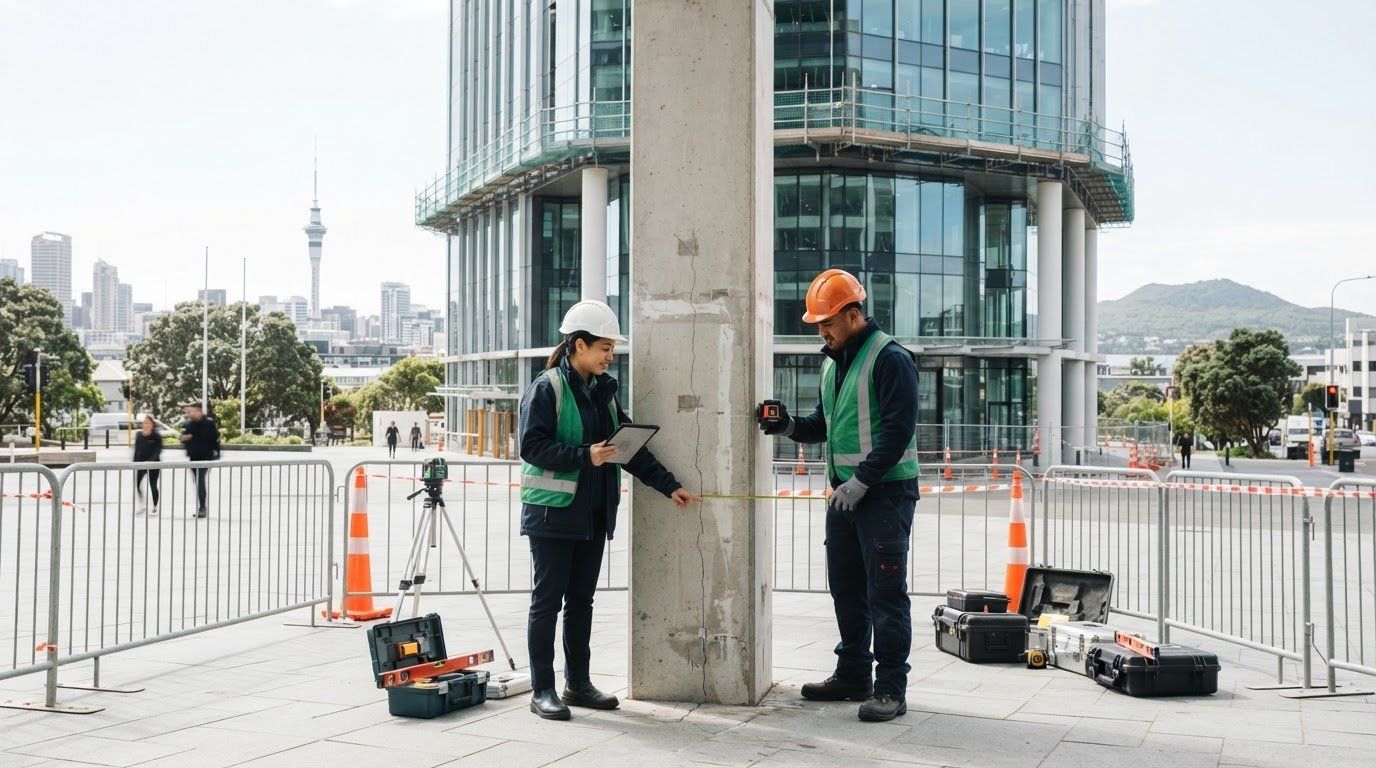
Start with four factors: safety, access, building function and disruption to business. A leak spreading near an electrical area, for example, may need prompt attention to manage risk and protect access. A damaged door that leaves an entrance unsecured can affect both safety and site operations. A loose or worn fitting in a low-use area may be suitable for planned repair if it creates no immediate hazard.
A visible defect isn’t automatically an emergency. Ask whether it is worsening, preventing a building function, creating a hazard or stopping staff, tenants or customers from using an area. Record what is affected and whether conditions are changing. This gives the repair assessment useful context instead of relying on appearance alone.
What “24/7” should mean in a repair brief
The phrase “24/7” can refer to different parts of a repair process: reporting a fault, arranging an assessment, attending the site or completing the repair. These aren’t interchangeable. A repair brief should spell out the response arrangements and work covered so expectations are clear before an issue occurs.
For 24/7 commercial property repairs Auckland, distinguish between being able to report an issue and having someone attend or complete the repair at any hour. Set out how urgent reports are handled, what information is needed to assess them and how the repair scope will be agreed. Clear wording helps property teams plan access, inform occupants and manage disruption without assuming every defect requires immediate attendance.
A practical brief also separates immediate risk control from the permanent repair. A leak, for instance, may first need to be contained, with its cause and full repair assessed separately. This helps the site team focus on safety and continuity while keeping the repair plan specific to the fault.
From Repair Report to Resolution: How Commercial Jobs Are Coordinated
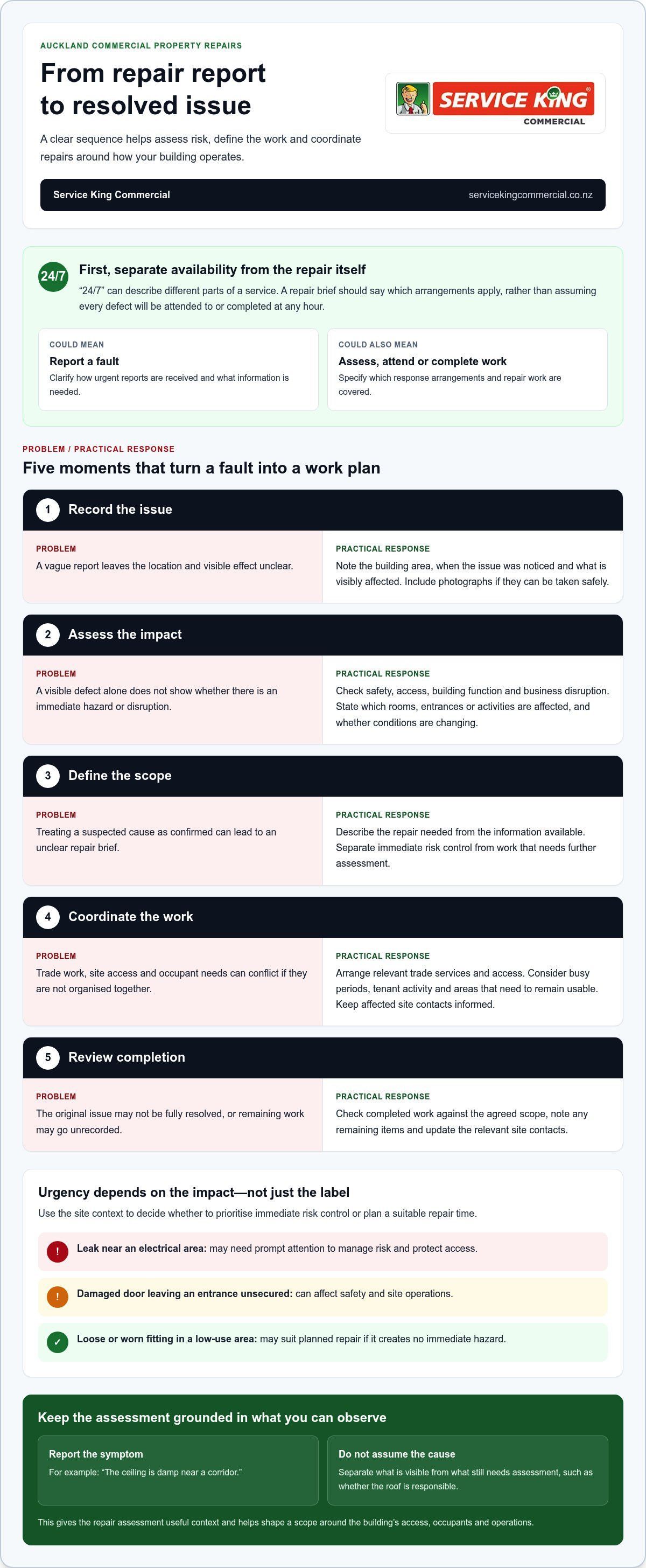
A useful repair report gives the site team a clear starting point. Record the location, what has changed and how the issue affects building use. Then assess the impact, define the work, organise access and trades, and review the completed job. This sequence turns a fault report into a practical work plan and distinguishes what has been observed from what still needs assessment.
Repair coordination in brief: record the issue, assess its impact, define the scope, coordinate people and site access, then review the completed work.
- Record the issue. Note the building area, when the problem was noticed and what is visibly affected. Include photographs if they can be taken safely.
- Assess the impact. Identify any safety concern, restricted access or disruption to building use. State which rooms, entrances or activities are affected.
- Define the scope. Describe the repair needed based on the information available. Separate immediate steps to manage the issue from work that needs further assessment.
- Coordinate the work. Arrange the relevant trade services, site access and communication with people affected by the work.
- Review completion. Check the agreed work against the original issue, note any remaining items and update the relevant site contacts.
Assessing the site, issue and operational impact
Specific site details make an assessment more practical. Record the exact area, visible damage, access restrictions and effect on occupants or business activities. For example, report that a ceiling is damp near a corridor rather than assuming the roof is the cause. Separate observed symptoms from possible explanations. This helps shape a suitable scope without treating an unverified cause as fact.
Plan work around how the site operates. A repair in a public entrance may need different access arrangements from one in a back-of-house store. Note busy periods, tenant activity and any areas that must remain usable. These details help organise the work around the building’s requirements.
Coordinating trades and keeping stakeholders informed
A clear scope helps identify the work and personnel required. Some jobs involve more than one trade or depend on access to a particular area. Service King Commercial’s trade services give property managers access to qualified personnel, while building repairs and maintenance can be tailored to site requirements. Keep the property manager, relevant tenants and site contacts informed about the affected area, access needs and work plan.
Agree who will share updates and what information stakeholders need. Tenants may need notice of a temporary route change, while a site contact may need to arrange access. Keep updates factual, record any changes to the scope and review the result against the original report. Planning 24/7 commercial property repairs Auckland this way keeps the job organised and the agreed work clear.
For Auckland properties needing coordinated repair and maintenance support, commercial building repair services can form part of a site-specific approach.
Compare Auckland Repair Support Using These Practical Criteria
Compare repair arrangements against your site’s conditions, not just the wording of a service label. A retail entrance, an occupied office and a warehouse have different access patterns and operational needs. For 24/7 commercial property repairs Auckland, separate expectations for reporting, assessment, attendance and completion. Then consider whether the repair scope, trade coordination and communication fit the building.
Response arrangements, scope and communication
Reporting an issue, assessing it, attending the site and completing the repair are distinct steps. Compare how each is described and look for a written scope that identifies the affected area and work required. Clear updates help property managers plan access and keep relevant site contacts informed. Suitable arrangements depend on the fault, building and repair requirements.
| Criterion | What to compare | Site factors to consider |
|---|---|---|
| Response arrangements | How an issue is reported, assessed and progressed to attendance or repair | Urgency, time of access and who can receive or report updates |
| Repair scope | How the affected building element, work required and any exclusions are described | Site type, fault location and whether the repair affects building function |
| Trade coordination | How required trades and site access are organised | Restricted areas, shared spaces and work that depends on other tasks |
| Communication | Who receives progress information and how scope changes are recorded | Tenants, staff, customers and the site contact responsible for access |
A comparison like this makes gaps easier to spot. A defined reporting channel, for example, doesn’t explain when assessment or attendance will occur. A broad repair description may also leave uncertainty about which building elements are included. Keep each stage and the agreed work visible in the job information.
Minimising disruption at occupied Auckland properties
At an occupied Auckland site, plan around how people enter, move through and use the building. A repair near a customer area may need a different sequence from work in a staff-only space. Note tenant access, business activity, delivery routes and any areas that need to stay open. Site-specific planning helps limit avoidable disruption.
Service King Commercial’s building repair and maintenance, exterior maintenance and trade services can be tailored to site requirements. Exterior work may need a different access plan from an internal repair, while trade services support the personnel needs of a commercial job. Scheduled maintenance provides a way to organise suitable work through planned site programmes.
Trade coordination is one part of the decision. For a closer look at that service category, see Commercial Trade Services in Auckland: A Practical Buying Guide. Consider each repair against the building’s access and operational needs, then compare how clearly the work and communication are set out.
Auckland Commercial Repair Readiness: Steps to Take When an Issue Arises
A clear first response helps the property team decide what needs attention and what information will help plan the work. Prioritise immediate safety and access before considering repair scheduling. For 24/7 commercial property repairs Auckland, a concise, factual report also helps distinguish an urgent issue from other faults awaiting assessment.
Record the issue and identify the immediate priorities
Start with the people and areas affected. Follow the property’s established safety and incident procedures, and keep people clear of any area that may be unsafe. Record what you can observe without trying to diagnose the cause. Note whether access is restricted, a building function is affected or occupants have had to change how they use the site.
- Prioritise safety and access. Follow site procedures and identify any immediate risk or blocked route. Make the affected area clear to the property team.
- Record when it appeared. Note when the issue was first noticed and whether it has changed since then. If the timing is uncertain, say so.
- Pinpoint the location. Give the building, floor, room or nearby landmark. Name the affected entrance, corridor or other area where relevant.
- Describe visible effects. State what can be seen or heard, such as water on a floor or a door that won’t close. Avoid guessing at the underlying cause.
- Explain the operational impact. Note any change to access, building use, tenant activity, staff work or customer movement.
Prepare a clear repair request for the property team
Once immediate priorities are addressed, prepare a short request that someone unfamiliar with the fault can act on. Include the site address, precise affected area, plain description of the issue and relevant access details. Note who can provide site access and any practical constraints, such as a shared entrance or a space in use during business hours.
- Attach a suitable photograph if it’s safe and practical to take one.
- State whether the issue is ongoing, intermittent or has stopped.
- List any areas or building functions affected.
- Include the name and contact details of the site contact.
- For several faults, describe each separately and identify the one with the greatest safety or operational impact.
Keep the report factual. A damp patch, for example, is an observation; the source of the moisture may still need assessment. Clear details help the property team understand the issue and shape a repair request around the site.
For Auckland building repairs and maintenance tailored to site requirements, discuss your Auckland property repair requirements with Service King Commercial.
How Service King Commercial Supports Auckland Property Repair Needs
Service King Commercial provides commercial building repairs and maintenance in Auckland, with locally based solutions tailored to each site. Property teams can address a building fault while considering how the work fits the property’s wider maintenance needs. A search for “24/7 commercial property repairs Auckland” may start with an urgent issue, but the suitable service scope still depends on the affected building element, the site and its operating requirements.
Repair needs can involve an internal building fault, an exterior defect or work better managed through a planned maintenance programme. Trade services give commercial property managers access to qualified personnel. Together, these services can address a specific repair while keeping the building’s condition and ongoing requirements in view.
Match the repair need to the right service scope
Start by identifying where the problem sits. Building faults connect with commercial building repair and maintenance. Exterior defects relate to exterior building maintenance, which helps preserve property condition and presentation. The scope can then be tailored to the commercial site and the work required.
- Building repairs and maintenance: address faults affecting building elements or their function.
- Exterior building maintenance: attend to exterior property needs and support the building’s condition.
- Trade services: provide access to qualified personnel for commercial property requirements.
- Scheduled maintenance: plan suitable ongoing work around the needs of an individual site.
Reactive repairs and scheduled maintenance serve different purposes. A repair responds to a reported fault; a tailored maintenance programme helps property teams organise suitable work beyond the immediate issue. For exterior requirements, the Auckland Commercial Exterior Building Maintenance Guide offers a related subject to consider alongside this repair approach.
Set out a clear next step for Auckland property teams
Before requesting a discussion, bring together the site address, affected area, observed issue and its effect on building use. Include relevant access limits and the site contact. For several items, identify which has the greatest effect on safety or operations. This gives the conversation a useful starting point and helps connect the repair need with a suitable service scope.
Service King Commercial’s Auckland repair and maintenance solutions are tailored to site requirements. The focus is on understanding the property need and the work involved, rather than treating every issue the same way.
Discuss commercial property repairs with Service King Commercial and outline the site, issue and operational priorities.
Put a Practical Repair Plan in Place
Make the next building issue easier to manage by keeping a simple repair record for your property. Note key site contacts, access arrangements and the process for reporting faults. Review the record when tenants, site use or building layouts change. Having this information ready helps your team share consistent details and make clear decisions under pressure.
For 24/7 commercial property repairs Auckland, focus on a useful scope and practical coordination rather than relying on a label alone. Give the repair team the information needed to understand the site and the issue. That creates a sound starting point for discussing the work.
Discuss your Auckland commercial property repair requirements with Service King Commercial. A clear brief is a good first step towards a repair approach that fits your property.
Frequently Asked Questions
Is exterior damage always an urgent commercial property repair?
No. Exterior damage needs urgent attention when it creates a safety, access or operational concern. A loose fitting above a walkway may require prompt risk management, while a surface blemish away from public access may be suitable for planned attention. Record its location, visible condition and any changes. Don’t enter an unsafe area to inspect it. The property team can use these details to decide what action is appropriate.
Can commercial repairs be completed while tenants remain on site?
Sometimes. It depends on the work, the area affected and whether people can continue using the premises safely. A repair in a tenant’s workspace may need access arranged around their activity, whilst work near a shared entrance may require a temporary route plan. Agree site access and communication with the property team and affected occupants. If people can’t be safely separated from the work, manage the area differently.
What happens if a repair reveals a wider building defect?
Pause and document the newly observed condition rather than extending the original scope by assumption. Record where it was found, how it relates to the reported fault and whether it changes access or building use. The property manager can then assess the additional issue and decide how it should be addressed. Keep the original repair record and note any revised work or follow-up needed.
How should a property manager record a completed commercial repair?
Update the original job record with the completion date, area worked on and a plain description of the work carried out. Note whether the reported problem was addressed, along with any remaining items or recommended follow-up. Add relevant completion photographs or documents if available, and record who reviewed the work. This gives the property team a useful maintenance history and helps identify recurring issues at the site.
How much detail should an Auckland repair request include?
Include enough information for someone unfamiliar with the site to locate and understand the issue. Give the Auckland site address, building area, observed symptoms, when they began and how they affect access or operations. Add the site contact, access instructions and any relevant occupancy constraints. If your search is for 24/7 commercial property repairs Auckland, describe separately what you mean by reporting, assessment, attendance or repair completion.
Can scheduled maintenance help reduce repeat commercial repair issues?
It can help property teams identify and address suitable maintenance needs before they develop into larger repair tasks, though it can’t prevent every fault. A record of repeated issues, previous work and building areas needing attention can help shape a maintenance plan around the site. Service King Commercial’s scheduled maintenance programmes are tailored to individual commercial requirements and can sit alongside reactive building repairs.
Recent Posts