
October 12, 2026
A repair list isn’t a maintenance system. A clear property manager maintenance Auckland process helps keep urgent faults, routine upkeep and contractor work organised across commercial sites. When several jobs compete for attention, consistent triage and clear updates help property managers, tenants and owners understand what needs to happen next.
Urgent repairs can easily push scheduled work aside. Add multiple sites, contractors and records, and decisions become harder to track. A practical process gives each issue a priority, assigns responsibility and records the work completed. It also helps coordinate repairs and upkeep while limiting disruption to occupants.
This guide sets out a workable approach for Auckland commercial properties. You’ll learn how to assess reported issues, distinguish urgent work from planned maintenance, coordinate contractors and keep useful records. It also covers tenant and owner updates, site-based maintenance planning and reporting, so decisions remain traceable from the first report through to completion.
Key Takeaways
- Build a clear process to log, assess, assign, inspect and close maintenance requests.
- Use consistent triage to weigh urgency, occupant disruption and the risk of a defect worsening.
- A practical property manager maintenance Auckland routine makes open jobs, responsibilities and completion evidence easier to track.
- Set review and reporting intervals around each building’s use, known issues and management agreement.
- Coordinate repairs, exterior upkeep and trade work through a site-specific maintenance programme.
Table of Contents
- What property manager maintenance in Auckland covers day to day
- How Auckland property managers can move a maintenance request to completion
- How to prioritise reactive repairs against planned property upkeep
- Create a practical Auckland maintenance review and reporting routine
- When Auckland property managers need a commercial maintenance partner
What property manager maintenance in Auckland covers day to day
Commercial property maintenance is the coordinated care of a building’s condition and function. It involves more than arranging a repair after something fails. Day-to-day work can include recording defects, assessing what action is needed, allocating responsibility, arranging access and documenting the outcome. The Property management overview provides broader context for the manager’s role, but each site’s process should reflect its agreements and operating needs.
For property manager maintenance Auckland, the manager is often the central point for communication and coordination. That doesn’t automatically make the manager responsible for every repair or approval. Owners, tenants and contractors have different roles, shaped by the lease, management agreement and work involved. Set those roles out clearly before requests arise.
Set clear maintenance responsibilities across each Auckland property
Map who reports issues, approves work, receives progress updates and arranges access. Use the lease and management agreement to define the process for each site rather than applying a blanket rule. For example, a tenant may report a defect, an owner or authorised representative may approve the work, and a contractor may carry out the repair.
Record these steps in a shared site reference. Clear ownership helps prevent duplicate instructions, jobs waiting unnecessarily for approval and work orders left open because no one knows who must act next.
Build a useful profile for every commercial site
Keep a concise record of each building’s use, operating hours, access restrictions and relevant contacts. Include practical details for arranging work, such as entry procedures and areas where occupants need to be coordinated. Record assets and systems that affect maintenance planning, along with known defects, recurring issues and previous work.
Keep the profile easy to find and update. Note location-specific observations, such as recurring water entry at a particular opening or heavy wear around entry barriers and loading bays. As specialist providers like apexgateworks.com note when managing commercial security doors and automated gates, documenting regular wear on perimeter hardware helps avoid unexpected access disruptions. These details help the manager assess new reports in context rather than assuming every site has the same exposure or maintenance needs.
A useful site record can include:
- Building and use: site address, primary use, operating hours and areas with restricted access.
- Contacts and permissions: tenant contacts, owner representative, approval limits and access arrangements.
- Assets and known issues: relevant equipment, reported defects, recurring problems and maintenance history.
- Work records: instructions given, contractor attendance, actions completed and any follow-up required.
Keep facts separate from assumptions. Note who reported an issue and when, describe what was observed, and identify any information still needed. A consistent record gives the manager and owner a shared reference when priorities change, occupants need updates or a recurring fault needs closer attention.
How Auckland property managers can move a maintenance request to completion
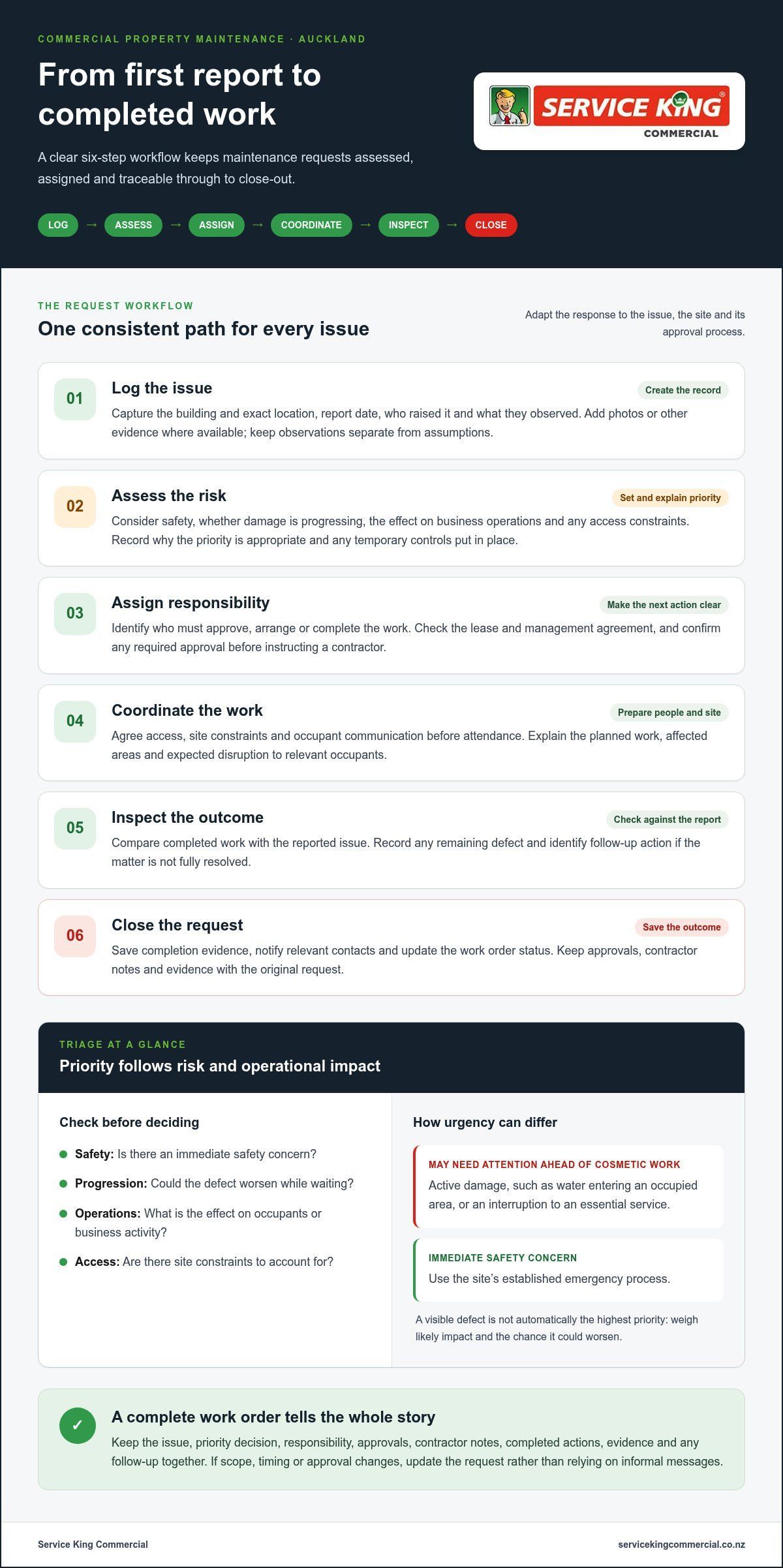
A request is only complete when the issue has been assessed, the work assigned and the outcome recorded. A consistent property manager maintenance Auckland workflow gives every report a clear path, whether it concerns a leaking tap, a damaged door or an interruption to an essential service. It also gives owners and occupants a reliable record of decisions and updates.
Use the same core sequence for each request, adapting the response to the issue, the site and the relevant approval process.
- Log the issue. Record the building and exact location, the date, who reported it and what they observed. Add photos or other supporting evidence where available. Separate direct observations from assumptions.
- Assess the risk. Consider safety, whether damage is progressing, the effect on business operations and any access constraints. Set a priority and record why it is appropriate.
- Assign responsibility. Identify who must approve, arrange or complete the next action. Confirm any required approval before instructing work.
- Coordinate the work. Agree access, site constraints and occupant communication with the relevant people before attendance.
- Inspect the outcome. Compare the completed work with the reported issue. Record any remaining defect or follow-up action.
- Close the request. Save completion evidence, notify the relevant contacts and update the work order status.
Triage building issues by risk and operational impact
Use the site’s established emergency process for immediate safety concerns. Active damage, such as water entering an occupied area, or an interruption to an essential service may need attention ahead of cosmetic work. A visible defect isn’t automatically the highest priority. Consider its likely impact and whether it could worsen while waiting. Record the reason for the decision and any temporary controls put in place.
Coordinate contractors, tenants and site access
Before work starts, confirm the affected area, access arrangements and operating constraints. Tell occupants what work is planned, which areas may be affected and what disruption to expect. If the scope, timing or approval changes, update the request rather than relying on informal messages. Keep approvals, contractor notes and completion evidence with the original work order.
A complete work order records the issue, decision, action and outcome. This makes it easier to review open work, explain priorities and see whether further action is needed. For commercial building repairs and maintenance, coordinate building repair and maintenance as part of a clear site process.
How to prioritise reactive repairs against planned property upkeep
Reactive repairs respond to a reported defect or failure. Planned upkeep schedules repeatable tasks before a fault is raised. Both belong in a sound maintenance plan, but they compete for access, contractor time and attention. A reported issue isn’t automatically the most urgent job. Assess its likely consequences alongside planned work, then record why one task takes priority over another.
For property manager maintenance Auckland decisions, use a consistent risk-and-impact test. Consider potential harm, ongoing damage, the effect on building function, disruption to occupants, access windows and what may happen if the work is delayed. Prevention doesn’t remove every failure, but planned attention can help manage avoidable deterioration.
Use risk, condition and occupancy to set work priorities
Consider the defect’s current condition and how it affects people using the site. A minor issue in a low-use area may wait, whilst a similar fault affecting a busy entrance may disrupt operations. Reassess the priority if the condition worsens, new evidence comes in or access changes. Keep the reason for any change with the maintenance record.
Illustrative priority matrix: Use these examples to guide consistent decisions, not as fixed classifications for every building.
- High impact: A suspected hazard or active leak affecting an occupied area may need prompt attention because safety or further damage could be at stake. Follow the site’s established emergency process where immediate safety concerns arise.
- Moderate impact: A faulty door that still functions but is becoming harder to secure may affect building use. Plan a response that reflects the condition, occupancy and consequences of delay.
- Lower impact: A scuff or cosmetic defect that doesn’t affect use or appear to be worsening may be recorded for a suitable planned visit.
- Planned task: A recurring check or upkeep task can be scheduled around site activity, unless an inspection identifies a new defect that changes its priority.
These examples show why a simple label alone isn’t enough. Add a short reason, such as “active water entry beside occupied workspace” or “cosmetic wear, no effect on access”. That explanation helps owners and site contacts understand the decision and makes later reviews more useful.
Choose planned upkeep or reactive work for the issue
Use planned upkeep for repeatable tasks that can be scheduled around building use, access and known site needs. Use reactive work when a specific defect or failure needs a response. Keep recurring tasks distinct from one-off repair requests, even when both relate to the same building element. This makes it easier to identify overdue upkeep, repeat faults and work that needs a revised plan.
Review priorities when conditions change, not just when the next routine review is due. A site-specific scheduled maintenance programme can help organise recurring tasks alongside reactive repairs, while keeping each decision and its rationale traceable.
Create a practical Auckland maintenance review and reporting routine
A review routine turns scattered work orders into a current view of building condition, outstanding decisions and completed work. Set the review interval around each building’s use, known issues and management agreement. A busy site with recurring faults may need closer attention than one with few open tasks. Use the agreed routine to check progress, flag delays and confirm which actions need an owner’s decision.
For property manager maintenance Auckland, keep the review focused on actions. Track each open request, its priority, assigned action, approval status, due date and completion evidence. Include the last update and next step, so a manager taking over a file can see where work stands without searching through separate messages.
Keep maintenance records useful and easy to act on
Store the original request, assessment, decision, approvals, work notes and close-out evidence together. Use consistent site and location labels to find related jobs. Flag recurring issues, such as repeated water entry in the same area, so managers can review patterns across visits or sites. Restrict access codes and personal or commercially sensitive details to people who need them for the work.
Review records for gaps as part of the routine. A request marked complete should have a clear outcome, not just a contractor attendance note. If work remains outstanding, record the reason, who owns the next action and when the status will be reviewed. For exterior upkeep, the Auckland commercial exterior building maintenance guide can inform site planning alongside the maintenance record.
Report status clearly to owners and occupants
Keep updates concise and specific to the recipient. Owners need a clear view of priorities, approvals and pending decisions. Occupants need to know what is planned, which area may be affected and whether access is required. Distinguish what has been observed from what is still being assessed. Don’t present an estimate, proposed visit or pending approval as completed work.
A useful update can follow this pattern: Issue: reported condition and location. Status: assessed, awaiting approval, scheduled or complete. Next action: responsible person and due date. Access: any arrangement needed. If the timing or scope changes, update the record and notify affected contacts. This keeps expectations aligned without lengthy explanations.
Use review findings to identify repair or trade requirements that could be coordinated, while keeping each work item traceable. For recurring exterior issues, the site’s history can also inform a tailored maintenance plan. Service King Commercial supports Auckland commercial properties with building repairs, exterior maintenance, scheduled maintenance and trade services.
Discuss coordinated maintenance support for your sites.
When Auckland property managers need a commercial maintenance partner
A maintenance partner can be useful when a site has several repairs, exterior upkeep tasks and trade requirements to organise at once. The need may also become clear when the same issues keep returning, work is spread across multiple sites, or property managers have limited time to coordinate access and follow-up. The aim is to make the work easier to plan around the building and its occupants.
A practical property manager maintenance Auckland plan should reflect each site’s use and operating needs. A busy commercial space may need work arranged around occupied areas, whilst a building with recurring exterior issues may need a planned approach alongside one-off repairs. Clear priorities help keep individual jobs visible within the wider maintenance programme.
Match maintenance support to the property’s operational needs
Building repairs and exterior upkeep are distinct work areas, but both affect a property’s condition and day-to-day use. Scheduled maintenance adds a planned structure for recurring tasks, tailored to the site rather than applied as a generic list. Trade services support a range of commercial property requirements. Together, these areas can be considered in one site-based plan, with each task and its status kept clear.
Consider coordinated support where:
- Several repairs or trade tasks need to be arranged across a site or group of properties.
- Exterior maintenance sits alongside internal building repair requirements.
- Recurring issues need to inform future scheduled maintenance.
- Work needs to fit around occupancy, access limits or normal site operations.
Service King Commercial provides Auckland commercial building repairs, exterior building maintenance, scheduled maintenance programmes tailored to site requirements, and trade services. Property managers can discuss related building needs as part of a practical, site-specific maintenance approach.
Prepare for a useful maintenance discussion
A short site summary makes it easier to focus the discussion. Gather the property address, building use, known defects, recurring concerns and access requirements. Note current priorities and any work waiting on a decision. Include operating constraints, such as occupied areas or access windows, so maintenance can be considered in context.
Keep the information factual. Separate confirmed defects from suspected causes, and distinguish completed work from tasks still under consideration. For several properties, prepare a brief summary for each site rather than combining different issues into one list. That keeps the discussion specific and makes it easier to identify which requirements may fit a site-specific programme.
For coordinated building repairs, exterior upkeep or scheduled maintenance, discuss commercial property maintenance in Auckland with Service King Commercial. Share the site requirements and current priorities to start a conversation about the work.
Set your next maintenance priority
Choose one practical next step: identify a site where recurring issues, open repairs or unclear priorities need a closer review. A focused starting point can help turn maintenance records into a workable plan for the property, rather than adding another broad task list.
Auckland property managers can use property manager maintenance Auckland planning to align building needs with how each site operates. Service King Commercial provides commercial building repair and maintenance, exterior building maintenance and remediation, and scheduled maintenance tailored to commercial site requirements.
Bring your site details and current priorities into the conversation. Start a discussion about your Auckland property and take the next step towards a maintenance approach that fits its practical needs.
Frequently Asked Questions
Is a property manager responsible for commercial building maintenance in Auckland?
A property manager can handle maintenance coordination when that work is delegated, but this does not make every repair decision theirs. The owner, manager and tenant may have different responsibilities under the lease and management agreement, including reporting issues, approving work, arranging access or completing agreed upkeep. Check both documents for the specific site and request. If responsibilities are unclear, record the question and seek agreement before assigning non-urgent work.
Does every commercial building repair in Auckland need council consent?
No single consent answer applies to every repair. Requirements depend on the work’s scope and the rules that apply to the building and proposed activity. Don’t assume a repair is exempt just because it appears minor, or that all work requires consent. Describe the proposed work accurately, then consult current Auckland Council guidance and relevant building information to understand the process for that job.
What should a property manager include in a maintenance report?
Give the reader a clear account of what has changed since the last update. State the current status, the decision made, work completed and any action still outstanding. Add useful supporting evidence, such as a dated photograph or contractor’s completion note, where available. Include the update date and identify who needs to act next. Keep estimates and proposed work distinct from confirmed completion.
How much should a commercial property manager budget for maintenance?
There’s no single budget that suits every commercial building. Planning depends on the building’s current condition, the scope of likely work, how the site is used and its maintenance history. Review past repairs and recurring issues to identify foreseeable upkeep, then separate planned tasks from uncertain or one-off repairs. Revisit the budget when inspections or new defects change the expected work, and align approvals with the management agreement.
Can a property manager coordinate maintenance across several Auckland buildings?
Yes. A consistent property manager maintenance Auckland process can give each building a comparable view of outstanding work while retaining separate site records. Use clear property identifiers and review open tasks by age, status and next action. Avoid treating similar defects as identical: access arrangements, occupancy and operating hours can change how work is planned at each site. This supports portfolio oversight without losing the practical detail needed for individual jobs.
What is the difference between a building defect and routine maintenance?
A building defect is a specific fault or deterioration observed in an element of the property. Routine maintenance is ongoing planned care, such as checking or maintaining building areas and components. The distinction depends on the condition and context: a routine check may reveal a fault that needs separate repair work. Record what was observed and where, so the issue can be assessed rather than assumed to be normal upkeep.
Recent Posts