
October 11, 2026
When searching for a trade contractor commercial property Auckland options, start with the work, the site and how much coordination your team can manage. The broadest list of trades is not necessarily the best fit for your property.
Quotes can be difficult to compare when they describe different work. An unclear scope makes costs and responsibilities harder to assess, while repairs can interrupt tenants, staff and daily operations. If each job needs a separate arrangement, property managers can spend more time coordinating work than managing the site.
This guide explains how to define the job, access, work sequence and disruption requirements before work begins. These details help you match the scope to your property’s needs and organise related maintenance more practically. Service King Commercial provides Auckland-based building repair and maintenance, scheduled maintenance, exterior building maintenance and trade services tailored to commercial site requirements.
Key Takeaways
- Match a trade contractor commercial property Auckland approach to the job’s scope and your site’s operational needs.
- Separate one-off repairs from ongoing scheduled maintenance to compare work arrangements more clearly.
- Build a useful work brief with the property location, affected areas, issue details and photographs where available.
- Consider how access, work timing and reporting can help limit disruption for tenants and staff.
- See how Service King Commercial’s building repair, exterior maintenance and trade services can support different commercial property requirements.
Table of Contents
- When Auckland commercial property needs a trade contractor
- What a commercial trade contractor can handle across your property
- Compare commercial contractor approaches before you appoint
- Prepare a clear Auckland commercial property work brief
- How Service King Commercial supports Auckland trade requirements
When Auckland commercial property needs a trade contractor
Keeping an occupied commercial property safe, functional and presentable takes regular attention. A damaged door, worn exterior finish or repair needed before a tenant handover can affect how people use the site. Even when the task is contained, arranging access and limiting disruption takes planning.
A commercial trade contractor provides support for defined repairs, upkeep and other property work. The right fit depends on more than the trade involved. Contractor fit means matching the job’s scope to the site’s operations, then agreeing how the work will be carried out and followed through. This gives property managers a practical basis for choosing between a one-off job and a wider maintenance arrangement.
Which commercial property issues call for trade support?
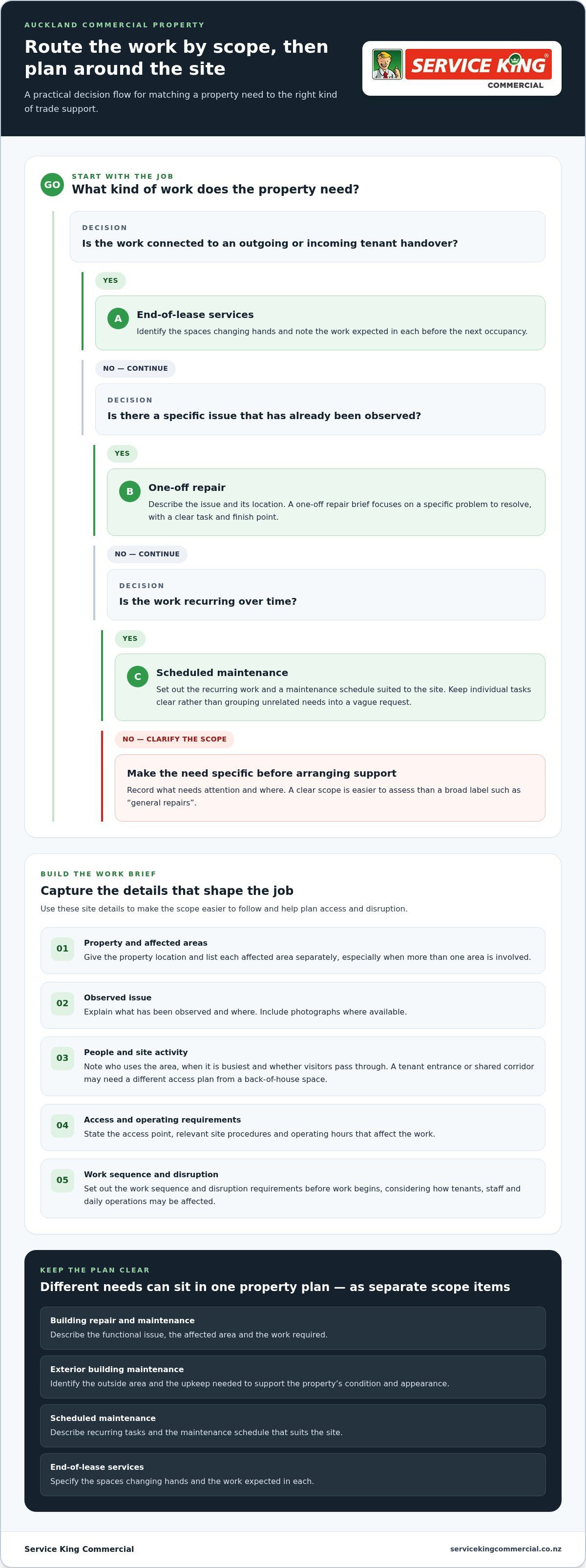
Trade support can suit building repairs, exterior building maintenance and work required at the end of a lease. A single repair, such as addressing damage in a shared area, has a clear task and finish point. Recurring upkeep is different: it involves identifying work that needs attention over time and setting a suitable maintenance schedule. Service King Commercial provides building repair and maintenance, exterior building maintenance, scheduled maintenance and end-of-lease services for commercial properties.
Occupancy affects the practical brief. A work area beside a tenant entrance may need a different access plan from a back-of-house space used mainly by staff. Note who uses the affected area, when it is busiest and whether visitors pass through. These details help define the work area and reduce avoidable interference with normal site activity.
Why Auckland site conditions shape the brief
Auckland commercial premises range from city offices to retail and industrial sites. The Auckland Central Business District (CBD) is one part of this varied commercial setting. Every property has its own access arrangements, occupied areas and operating patterns. A useful brief records these site details instead of relying on a general description of the job.
For example, a repair near reception may need to be planned around visitor movement. Work in a shared corridor may require communication with tenants and staff about which route will remain available. State the access point, relevant site procedures and operating hours that affect the work. If several areas are involved, list them separately so the scope is easy to follow.
Planned work and reactive jobs both have a place. A scheduled task can be arranged around known site routines. An unplanned repair starts with an issue already present, so describe what has been observed. Either way, a useful scope is essential. For trade contractor commercial property Auckland requirements, clearly describe the job and site to make appropriate trade support easier to organise.
Service King Commercial is an Auckland-based business providing commercial trade services, building repairs, exterior upkeep and scheduled maintenance tailored to site requirements. This local, site-focused approach helps property managers describe the work in operational terms: what needs attention, which areas are affected and how the premises are used.
What a commercial trade contractor can handle across your property
Commercial properties often need different types of work over time. A repair may address a functional problem inside the building, while exterior upkeep supports the condition and presentation of the premises. A tenant change can bring a separate set of handover tasks. Defining each need helps keep the scope practical and shows whether the work is a standalone job or part of a wider property plan.
A one-off repair brief describes a specific issue to resolve; an ongoing maintenance requirement sets out recurring work tailored to the site. This distinction helps property managers organise the right support without bundling unrelated tasks into a vague request.
Match the service scope to the work
Start with the affected area and the work required. Building repair and maintenance can address structural or functional issues that affect how commercial premises are used. Exterior building maintenance concerns the outside of the property and supports its condition and appearance. Describe the observed issue and its location so the work can be scoped around the actual need, rather than a broad label such as “general repairs”.
End-of-lease services can support work for an outgoing tenant or preparation for an incoming one. Note which areas are changing hands and what needs attention before the next occupancy. Clear handover requirements help distinguish tenant-related tasks from ongoing property upkeep. For practical incoming tenant property preparation , organise the brief around the spaces being handed over and the work expected in each.
Bring related property needs into one plan
A site may have a repair to address alongside exterior upkeep and recurring maintenance tasks. These needs can sit within one property plan while remaining separate scope items. For example, list the repair, exterior work and maintenance tasks individually, then record the area and purpose of each. This keeps priorities visible and helps managers coordinate work across different parts of a property.
Service King Commercial provides access to licensed tradespeople for commercial property requirements, alongside building repairs, exterior building maintenance, scheduled maintenance and end-of-lease services. Maintenance arrangements are tailored to each site. A suitable plan can reflect the property’s spaces, observed needs and preferred maintenance schedule without treating every task as the same kind of job.
For commercial exterior building maintenance , define the relevant exterior areas and the upkeep required. For handover work, identify the outgoing or incoming tenant requirements. These distinctions help you set priorities and keep unrelated tasks from being overlooked in a combined request.
- Repair: identify the fault, affected area and practical outcome required.
- Exterior upkeep: describe the building areas and presentation or condition needs.
- Handover: list the spaces and tasks connected with the tenant change.
- Scheduled maintenance: outline recurring requirements for the individual site.
When a property has several needs, Service King Commercial can help organise the brief around its building repair, exterior, scheduled maintenance and trade services. See commercial property trade and maintenance support to understand how these services relate to site requirements.
Compare commercial contractor approaches before you appoint
A broad service list doesn’t show how well a contractor’s work model fits your property. A defined repair and recurring upkeep have different scopes, schedules and coordination needs. An arrangement that suits one job may not be right for every requirement across the site.
Compare defined responsibilities and site fit, not service-list length. Use the work scope, service schedule, access arrangements and reporting expectations to assess each approach. This makes it easier to compare a one-off trade engagement with scheduled maintenance against what your site actually needs.
One-off contractor or ongoing maintenance support?
A contained reactive job, such as repairing a specific damaged area, can be briefed as a one-off engagement. Recurring inspections or upkeep need a suitable schedule and a clear record of the tasks included; for commercial sites with dedicated infrastructure such as wastewater systems, trade specialists such as Lil' Stinky Septic Service illustrate how scheduled pumping and routine inspections keep essential services operating smoothly. If work is needed regularly, consider whether an ongoing maintenance arrangement tailored to the property would make coordination more practical.
Neither model is automatically better. Match the arrangement to the work’s frequency, the number of areas involved and the effort required to coordinate each visit. A single issue may not call for a recurring plan. A property with repeated maintenance needs may benefit from organising those requirements together.
| Comparison point | Single-job trade engagement | Ongoing scheduled maintenance |
|---|---|---|
| Work scope | A defined task, affected area and intended outcome. | Recurring tasks set out for the site. |
| Service cadence | Arranged around the specific job. | Planned at intervals suited to the property’s requirements. |
| Site access | Access is organised for the work area and job. | Access arrangements can be considered across scheduled visits. |
| Reporting | Completion details relate to the agreed task. | Records can help track scheduled work and outstanding items. |
Compare communication, safety and close-out
Clear communication keeps work aligned with the brief. Compare how the scope, affected areas and access arrangements are described, and how updates will be handled. On an occupied site, this helps property managers coordinate with tenants, staff and others who use the space.
Safety planning is another part of the comparison. Consider how the work area, site access and people nearby are accounted for in the job plan. Agree what completion information will be provided and who is responsible for closing out the work. This could include recording completed tasks and identifying any relevant outstanding items.
For trade contractor commercial property Auckland requirements, decide whether the site needs a defined job, a recurring maintenance plan or a combination of both. Service King Commercial tailors scheduled maintenance to individual commercial site requirements and provides building repair, maintenance and trade services. Explore commercial trade and maintenance support as you shape an arrangement around your property’s work scope.
Prepare a clear Auckland commercial property work brief
A clear brief gives a contractor a usable picture of the job before work is arranged. It also separates what has been observed from what still needs assessment. For trade contractor commercial property Auckland requirements, record site details and operating constraints alongside the repair or maintenance request. Keep the information practical and factual.
Information to include in the job scope
Describe the property and affected area in plain terms. “Water staining beside the second-floor meeting room” gives a location and an observation without assuming the cause. Add relevant photographs where available, and note any history that may help explain the issue. Keep confirmed details separate from possibilities so the work can be scoped around the actual requirement.
- Identify the site. Give the property address, building name if relevant, and the best point of contact for arranging access.
- Pinpoint the work area. Name the floor, room, entrance or exterior section. If several areas are involved, list each separately.
- Describe what you’ve observed. State what is damaged, not working or due for upkeep. Include when the issue was noticed if known.
- Attach useful photographs. Add clear images that show the affected area and its context. Label them so each image can be matched to the location in your brief.
- Record site conditions. Note occupancy, tenant or visitor activity, access restrictions, operating hours and preferred work windows. Include coordination needs, such as notifying tenants or keeping a route available.
- State the required outcome. Explain what needs to be repaired or maintained. Add relevant end-of-lease, handover or scheduled maintenance context, and mark any assumptions clearly.
Set expectations for work updates and completion
Before work begins, record who will receive updates and how access arrangements will be communicated to relevant site contacts. Specify what completion information you need for property records, such as a summary of work carried out and any agreed follow-up items. Clear expectations make it easier to track progress and close out the job without leaving responsibilities unclear.
Keep the brief focused. If the cause of an issue is uncertain, describe the evidence rather than presenting a guess as fact. If the request includes several tasks, separate them so each has a location, a clear outcome and relevant access notes. This gives the contractor a sound basis for tailoring the work to the site.
Service King Commercial tailors commercial property repair, trade and scheduled maintenance arrangements to site requirements. Discuss your commercial property requirements with a clear brief to help shape the work around your premises.
How Service King Commercial supports Auckland trade requirements
Commercial property work can involve a single repair, exterior upkeep, scheduled maintenance or tasks connected with a tenant handover. Service King Commercial provides these services for Auckland commercial properties, with arrangements tailored to each site’s requirements. This gives property managers a local option for organising work around the building, the areas involved and how the premises operate.
A local service approach for commercial premises
Service King Commercial operates as an independent Auckland business. Commercial property repairs and maintenance are delivered by qualified personnel, with access to licensed tradespeople for trade requirements. This brings defined repair work and broader maintenance needs into a locally based service relationship, without assuming every job needs the same trade or arrangement.
The service scope can be shaped around the requirement. A building repair brief can focus on the affected area and intended outcome. Exterior building maintenance can address outside areas requiring upkeep. Scheduled maintenance plans are tailored to individual site requirements, while end-of-lease services can support work associated with a property handover.
- Building repair and maintenance for defined issues affecting a commercial premises.
- Exterior building maintenance for upkeep of the property’s external areas.
- Scheduled maintenance arranged to reflect the needs of the individual site.
- End-of-lease services for work connected with outgoing or incoming tenant handovers.
- Trade services with access to licensed tradespeople for commercial property requirements.
These services can cover separate tasks within one property plan. For example, a manager may need to arrange a repair, maintain exterior areas and schedule recurring upkeep. Keeping each requirement distinct makes it easier to set a clear scope while tailoring the overall arrangement to the site.
Move from property requirement to next step
Start with the brief you’ve prepared: the property location, affected areas, what you’ve observed and the outcome required. Add relevant photographs where available, along with occupancy details, access constraints and operating considerations. Separate confirmed information from assumptions. This frames the work around the premises rather than a generic service request.
For a trade contractor commercial property Auckland requirement, a practical service arrangement should reflect both the task and the way the site is used. Service King Commercial tailors building repair, exterior maintenance, scheduled maintenance and trade support to commercial site requirements. End-of-lease services can also be part of the brief when tenant handover work is involved.
Use your site details and work scope to start the conversation. Talk to Service King Commercial about your Auckland property.
Put your property work brief into action
A well-scoped job gives your property team a clear reference for priorities, access decisions and completion records. Keep the brief with your site notes and update it if requirements change. Over time, this record can help distinguish a one-off issue from work that may suit a planned maintenance approach, without setting a schedule before the need is clear.
Before arranging a trade contractor commercial property Auckland project, identify the outcome that matters most. It may be resolving a defined fault, preparing an area for handover or organising upkeep around site operations. Share the relevant details and constraints, then agree how updates and close-out will be handled. A practical arrangement matches the work scope and can be organised around how your premises are used.
Use your prepared brief as the starting point for a focused conversation with Service King Commercial about your site’s requirements. The work can then be considered in the context of your property and its operating needs. Discuss the next step for your commercial property. Clear information gives you a sound basis for moving ahead.
Frequently Asked Questions
What does a trade contractor do for a commercial property?
A trade contractor carries out defined repair, maintenance or property work on commercial premises. The job may address one part of a building or contribute to broader upkeep. For example, a property manager might arrange a repair in a shared space separately from planned work elsewhere. The brief sets out the required outcome and site conditions, helping distinguish trade work from general property management or tenant coordination.
How do I compare commercial trade contractors in Auckland?
Compare the proposed work, responsibilities and arrangements for the occupied site, rather than relying on how many services appear in a list. For each quote, note which areas and tasks it covers, how access will be managed, who will receive updates and what completion information is expected. This makes trade contractor commercial property Auckland options easier to assess on a like-for-like basis, even when the proposed work arrangements differ.
Can one contractor support both repairs and scheduled maintenance?
Yes. Service King Commercial provides building repair and maintenance as well as scheduled maintenance for commercial properties. These services can be considered together when a site has a specific repair and planned upkeep needs. Keep each task clear in the brief, including its location and intended outcome. The maintenance arrangement can then be tailored to the property, rather than assuming every repair should become part of a recurring schedule.
What information should I include in a commercial property work brief?
Include the site address, precise work location, what you’ve observed and the outcome you need. Add relevant photographs and note access arrangements, occupancy patterns and any site contact who can coordinate entry. If you have records of earlier work or related maintenance, include them as context. Label observations separately from suspected causes. This helps the contractor understand what is known and where the scope may need assessment.
Can trade services help prepare a commercial property for a new tenant?
Yes. End-of-lease services can support commercial property handover and make-good work for outgoing or incoming tenants. To make the request useful, identify the spaces changing hands and list the agreed tasks for each area. Note any handover date or site coordination requirements that affect planning. Keeping this work distinct from routine maintenance helps property managers track what belongs to the tenant transition.
Does Service King Commercial provide trade and maintenance services in Auckland?
Yes. Service King Commercial is an Auckland-based independent business providing commercial trade services, building repairs, exterior building maintenance, scheduled maintenance and end-of-lease services. Its arrangements are tailored to individual site requirements. To frame a request around the building’s practical needs, outline the premises, work areas and any operating constraints.
Recent Posts