
October 16, 2026
After-hours maintenance is an operational control, not just an emergency call-out. A leak, damaged entry or failed building fixture can interrupt trading, affect tenant access or create a safety concern. A clear plan for after hours building maintenance Auckland commercial sites rely on helps teams respond while limiting avoidable disruption.
It is not always obvious which defect needs urgent attention and which can wait for a planned visit. Site access, tenant notifications and trade coordination also take time, especially when a building is quiet or partly occupied. Setting out who reports an issue, how it is assessed and what happens next gives property teams a practical way to manage work outside normal hours.
This guide explains how to triage urgent building issues, plan maintenance around site operations and choose an arrangement that reflects access and tenant requirements. It also covers how scheduled maintenance and trade services can support commercial premises. Service King Commercial provides building repairs, exterior building maintenance and scheduled maintenance tailored to commercial site requirements in Auckland and across New Zealand.
Key Takeaways
- Separate immediate safety risks and active damage from defects that can be scheduled for later work.
- Use a consistent triage sequence to record the fault, its location, its impact and the site access conditions.
- Compare reactive call-outs, planned out-of-hours work and broader maintenance programmes by scope, communication and record-keeping.
- Prepare site contacts, access instructions and tenant notifications before arranging after-hours building maintenance Auckland sites need.
- Match building repairs, trade services and scheduled maintenance to your property’s operating needs and access requirements.
Table of Contents
- After-hours building maintenance in Auckland: what counts as urgent?
- How to triage after-hours building maintenance at an Auckland site
- Compare after-hours building maintenance arrangements in Auckland
- Prepare an Auckland commercial site for after-hours maintenance
- Arrange Auckland after-hours building maintenance with Service King Commercial
After-hours building maintenance in Auckland: what counts as urgent?
A building fault can affect more than the room where it starts. Water entering a shared corridor may create a slip hazard, restrict access and interrupt business across several tenancies. A damaged entry can leave stock, equipment or people exposed. For commercial sites, urgency depends on the risk to people, whether damage is continuing and what the fault prevents the site from doing.
Commercial after-hours maintenance is building work arranged outside a property’s normal operating hours to address urgent risks or complete work with less impact on daily operations. It can range from making an unsafe area secure to scheduling a repair after tenants and customers have left. The Facility management overview places maintenance within the wider work of managing a building’s operations and assets. This perspective helps teams treat after-hours decisions as part of site management, not just a trade call-out.
Urgent building issues versus work that can be scheduled
Assess three things: safety, active damage and operational impact. If anyone faces immediate danger, keep people away from the hazard and contact emergency services. For other faults, decide whether the problem is getting worse or stopping essential access or use. Record what is affected and arrange follow-up based on the risk, not simply the time the report arrived.
| Immediate action | Planned follow-up |
|---|---|
| Water is entering through a roof or window during rain and spreading into occupied or shared areas. | A small, inactive stain with no current water entry can be inspected and repaired through planned work. |
| An entry door or access point is damaged and leaves the building unsecured or prevents safe entry. | A door closer or fitting is worn but still allows the space to be used safely. |
| A shared-area fault creates a clear hazard or blocks a key route used by tenants, staff or customers. | A local fault affects a non-essential area, with no active hazard or damage, and can be isolated until a scheduled visit. |
These are starting points, not automatic rules. A fault that seems minor in one tenancy may have wider consequences if it affects a shared entrance, accessible route or building service.
Why commercial sites need an after-hours plan
Normal operating hours vary between offices, retail sites, warehouses and mixed-use buildings. A repair during trading may interrupt customers; work in a shared corridor may restrict tenant access; noise near neighbouring businesses may create another constraint. Decide in advance which areas must remain open, who can approve access and how affected occupants will be notified.
Auckland rain and wind can make an exterior defect time-sensitive. Loose materials, damaged cladding or water ingress may worsen if conditions continue, while a dry spell can provide a suitable window for planned repairs. Record the location, visible impact and any change in the fault so the next decision reflects the site conditions. A clear plan helps property teams judge when after hours building maintenance Auckland sites need should happen immediately and when it can be organised around operations.
How to triage after-hours building maintenance at an Auckland site
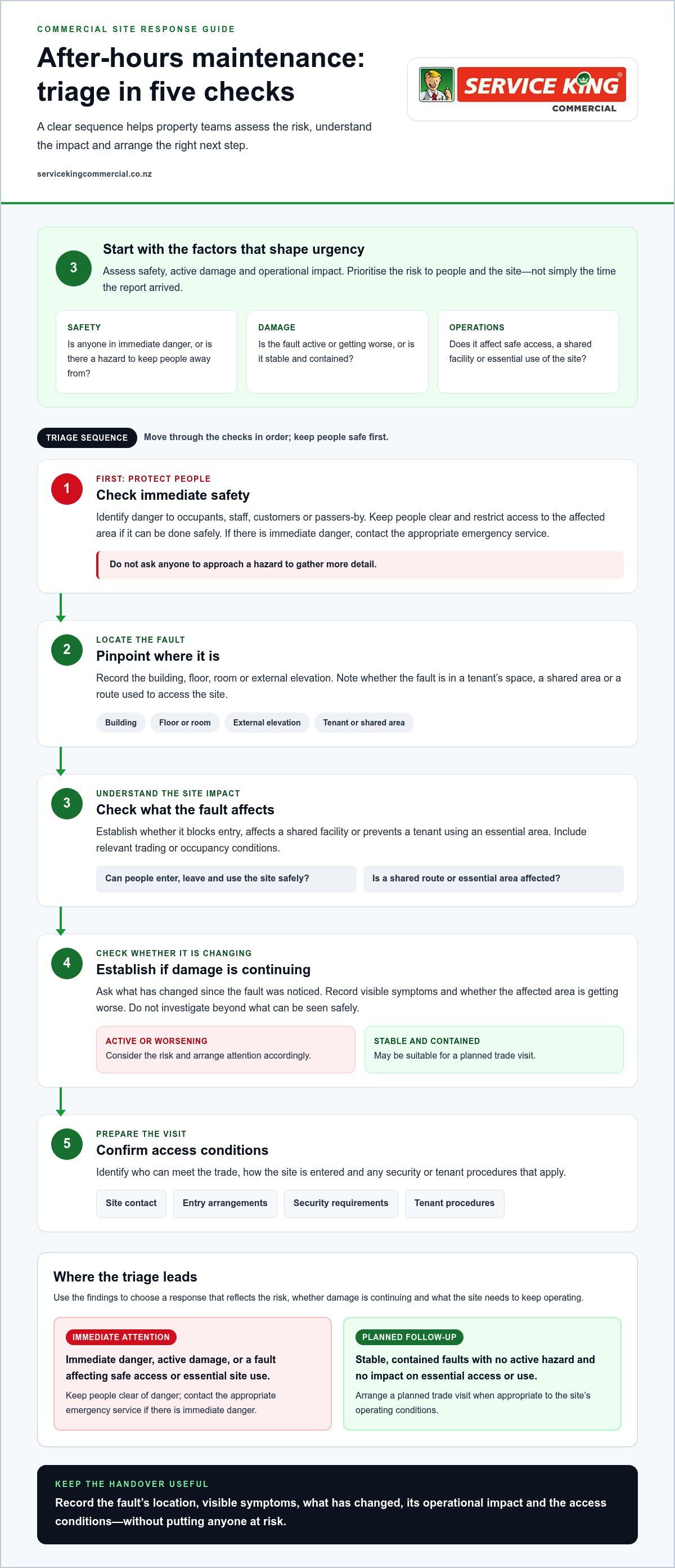
A consistent triage process helps a property manager make a clear decision before arranging work. It also gives the person taking over the issue useful facts, rather than a vague report such as “something’s leaking”. Keep people safe first. Then establish what is affected, whether the fault is changing and what access a trade visit would require.
Assess safety, damage and operational impact
Do not ask staff or tenants to approach a hazard to gather more detail. If there is immediate danger, keep people clear and contact the appropriate emergency service. Once it is safe to assess, check whether the fault is active, which areas or building functions it affects, and whether people can still enter, leave and use the site safely.
Commercial maintenance triage starts with people’s safety, then checks the fault’s location, impact, activity and access requirements.
- Check immediate safety. Identify any danger to occupants, staff, customers or passers-by. Restrict access to an affected area if it can be done safely. Escalate immediate danger to the appropriate emergency service.
- Pinpoint the location. Record the building, floor, room or external elevation. Note whether the fault is in a tenant’s space, a shared area or a route used to access the site. A precise location helps the person arranging work understand where attention is needed.
- Establish the operational impact. Find out whether the issue blocks entry, affects a shared facility or prevents a tenant from using an essential area. Include relevant trading or occupancy conditions. A fault in a low-use back room may have a different priority from one affecting a main entrance.
- Check whether damage is continuing. Ask what has changed since the fault was first noticed. Record visible symptoms and whether the affected area is getting worse. Avoid investigating beyond what can be seen safely. If the issue is stable and contained, it may be suitable for a planned trade visit.
- Confirm access conditions. Identify who can meet the trade, how the site is entered and any security or tenant procedures that apply. Note restricted areas and whether work could affect other occupants.
Set the next action and document the issue
Log the time reported, the reporter’s name and contact details, the affected area, visible symptoms, known impact and access instructions. Keep the wording factual. “Water visible beneath the window in the second-floor corridor” is more useful than “serious leak” when the cause and severity are not known.
Record the decision: urgent attention or a scheduled trade visit. Assign a named site contact to coordinate access and updates, and state the next action without promising a response time. If new information changes the risk, update the record and reassess. The Facilities Management Association of New Zealand provides a local facilities management reference point for property teams developing consistent site processes.
For planned building repairs and ongoing site requirements, commercial building maintenance support can help property teams organise work around their operational needs.
Compare after-hours building maintenance arrangements in Auckland
The right arrangement depends on how the site is used, which building assets need attention and how much disruption a repair could cause. A retail property with evening trading has different access windows from an office that is empty overnight. For after hours building maintenance Auckland property teams can compare three broad approaches: reactive call-outs, scheduled work outside operating hours and a wider maintenance programme.
| Arrangement | Scope | Access and communication | Records and continuity |
|---|---|---|---|
| Reactive call-outs | Work is arranged in response to a reported fault. | Access is organised for the individual job. The site contact shares the fault details and updates affected occupants. | Records relate to each request. Follow-up may need to be arranged separately. |
| Scheduled out-of-hours work | Known repairs or disruptive tasks are booked for a suitable period outside normal operations. | Tenants, security and site contacts can be advised before work begins. Access can be planned around affected areas. | Work is recorded against the scheduled task. Further maintenance is planned as needs arise. |
| Broader maintenance programme | Building repairs and scheduled maintenance are organised around site requirements over time. | Access needs and operating patterns inform the work schedule. Property teams can coordinate communication across affected areas. | Ongoing records help teams track work and identify follow-up needs across the programme. |
Choose an arrangement that matches site operations
Reactive work can suit isolated faults that are difficult to predict. Planned out-of-hours work is useful when a task is known in advance and daytime activity would make access difficult or disruptive. Where a property has recurring maintenance needs across several areas, a tailored programme can bring related tasks into an organised schedule. It supports planning, but does not replace the process for assessing a new fault that may need urgent attention.
Consider tenant activity, trading hours, shared access routes and the building’s maintenance needs together. A job in a common corridor may need different coordination from work in a vacant unit. Choose an arrangement that defines what work is covered and how it fits alongside daily operations.
Assess scope, coordination and accountability
Set clear work boundaries. Note the assets or areas covered, what sits outside the agreed scope, who can approve work and who manages site access. A named contact gives tenants and trades a clear point of coordination. This also helps property teams keep updates, decisions and follow-up tasks together instead of tracking each trade separately.
Coordinated trade services can simplify the administration involved in organising work across different building requirements. Service King Commercial tailors building repairs, scheduled maintenance and trade services to individual site needs. For more detail on coordinating trade work, see the commercial trade services buying guide.
Prepare an Auckland commercial site for after-hours maintenance
Good preparation makes maintenance easier to coordinate and helps avoid confusion at the site. Before work begins, make sure the people arranging access, managing tenants and overseeing the task have the same practical information. This matters on shared sites, where one repair can affect a common entrance, car park, service area or neighbouring business.
Set up access and communication before work begins
Keep access instructions brief, current and available to the people coordinating the work. Identify who can authorise entry, who will meet the trade and which security steps apply. Note any restricted areas or site-specific conditions. If work could affect tenants or neighbouring businesses, plan how and when to notify them, and explain which areas may be affected.
- Site contacts: Record the authorised contact and an alternative contact for access coordination.
- Entry arrangements: Provide the agreed entry point, access procedure and relevant security instructions.
- Affected areas: Identify the work location, nearby shared spaces and routes that need to stay clear.
- Occupant communication: List the tenants or neighbouring businesses who may be affected and how they will receive a notice.
- Work boundaries: State the agreed task and any limits on access or activity in occupied areas.
For disruptive tasks, give affected people practical details. State where the work will take place, what access may change and who can answer site-related questions. Avoid broad notices that leave tenants unsure whether their space or usual entry route is involved.
Create a clear work record and handover
Record the original fault, the agreed scope, access arrangements and the work status. At completion, note what was done and whether follow-up is needed. Keep finished work separate from issues that still need assessment or repair. This gives property teams a clear handover and helps prevent an unresolved defect from being mistaken for a completed job.
A useful record can include the report date and time, affected area, visible symptoms, site contact, work completed and outstanding actions. For exterior tasks, note the location and the part of the building involved. The Auckland exterior building maintenance guide offers related guidance for planning upkeep beyond the interior of the site.
Clear access notes and records support a more organised approach to after hours building maintenance Auckland properties require. For site-specific building repairs, exterior maintenance and scheduled work, commercial maintenance information provides a starting point.
Arrange Auckland after-hours building maintenance with Service King Commercial
After-hours building maintenance Auckland property teams arrange should fit the site’s operating pattern. A retail premises, office building and warehouse have different access needs, tenant activity and maintenance priorities. Service King Commercial supports commercial properties with building repairs, scheduled maintenance and trade services tailored to individual site requirements. This gives property teams a practical starting point for planning work around building operations.
Match Service King Commercial services to the site requirement
Building repairs address faults affecting commercial premises and their day-to-day use. Scheduled maintenance helps property teams organise upkeep around site-specific needs, rather than treating every task as an isolated request. Where the brief involves the building exterior, exterior building maintenance can form part of the work. Service King Commercial delivers commercial building repair and maintenance with qualified personnel, shaping the scope around the property and its requirements.
Before arranging a maintenance discussion, bring together the key details:
- Property type and use: Describe the site and its main operating activities.
- Issue or maintenance need: State what has been reported, where it is and what is affected.
- Operating hours: Explain when the site is occupied and which work windows may reduce disruption.
- Access requirements: Note entry arrangements, security procedures, restricted areas and the site contact.
- Work scope: Separate the immediate task from any related repairs or scheduled upkeep.
Set out the next step for an Auckland property team
A clear scope makes it easier to plan the maintenance work. Include whether the request concerns a current fault, planned repairs or ongoing upkeep. Identify tenant access needs and any shared areas that could be affected. For exterior work, specify the building area and the issue observed. These details help connect the property’s operating requirements with suitable building repairs, trade services or scheduled maintenance.
Service King Commercial provides commercial property maintenance in Auckland, with schedules tailored to individual sites. If your premises need ongoing attention, a site-specific maintenance arrangement can help organise work around its use and access conditions. Set out the required scope, relevant work windows and known constraints during planning. This keeps the discussion grounded in the building’s needs, without assuming every site requires the same maintenance approach.
Set out your property type, issue, operating hours and access needs to begin a focused discussion about your site. Contact Service King Commercial to discuss your commercial maintenance requirements.
Put a workable maintenance plan in place
Turn your site’s operating requirements into a practical maintenance brief. Note the areas that need attention, the times when access is easiest and any tenant or security arrangements that shape the work. This gives your property team a clear basis for planning after hours building maintenance Auckland businesses can organise around day-to-day operations.
Service King Commercial supports Auckland commercial properties with building repairs delivered by qualified personnel and scheduled maintenance programmes tailored to individual site requirements. A site-focused discussion can connect your building’s needs with an appropriate maintenance scope, without assuming every property follows the same pattern.
Set out the property type, maintenance priorities and access considerations, then discuss your Auckland building maintenance requirements with Service King Commercial. A clear starting brief helps you plan the work and keep your premises ready for the people who rely on them.
Frequently Asked Questions
Can after-hours building maintenance be scheduled as recurring work?
Yes. Recurring tasks can be planned around a site’s operating hours and maintenance priorities. For example, a property team might group checks of several shared areas into a planned visit to reduce repeated access arrangements. Set out the task scope, entry details, site contacts and how completed work will be recorded. Scheduled upkeep helps organise routine tasks and should remain distinct from the process for reporting a new urgent fault.
How much does after-hours building maintenance in Auckland cost?
The cost of after hours building maintenance Auckland sites require depends on the work scope, access, timing, materials and trade requirements. A repair in a restricted plant area may need different preparation from work in an open tenancy. Describe the property, fault and affected areas clearly so the task can be scoped appropriately. Include known access constraints or related work. The cost depends on the specific commercial maintenance job.
Can one maintenance plan cover several Auckland commercial sites?
A property team can coordinate maintenance information across several sites by keeping a consistent record of each building’s priorities, contacts and completed work. For example, a shared overview can help compare outstanding tasks, while individual site records capture local access details and building-specific needs. Each property still needs its own task scope and access arrangements. This approach supports clearer coordination without assuming that every location follows the same schedule.
Is after-hours building maintenance suitable for retail premises?
It can suit retail work where completing a task outside trading hours may reduce disruption to customers and staff. Plan around the work area, entry and security procedures, and any tenant communication needed. Allow time to prepare the premises for opening, including clearing work areas and restoring normal access. Suitability depends on the task and site conditions. Some repairs may need a different work window or staged approach.
Will after-hours building work disturb neighbouring businesses?
It may, depending on the task, noise and how people or materials move through shared areas. Before work starts, identify nearby occupants who could be affected and share relevant access or disruption details. Plan noisier or obstructive tasks for a suitable window, and follow the site’s communication and security procedures. In a multi-tenancy building, coordinate with property management so notices reach the right businesses and shared access arrangements are clear.
Can commercial cleaning be coordinated with after-hours building maintenance?
Yes. Cleaning and maintenance requirements can be considered together when planning site access and the order of work. Service King Commercial provides commercial cleaning alongside building maintenance services. Keep the tasks distinct in the site plan: repairs and trade work may leave areas that need cleaning afterwards, while scheduled cleaning has its own scope. Set out the work areas, sequence and timing so tenants and site contacts know what to expect.
Recent Posts