
October 31, 2026
A trade title alone doesn’t show whether someone is currently authorised or has a disciplinary history. For licensed tradespeople working on commercial property in NZ, check a Licensed Building Practitioner’s entry on the Public Register, which shows whether they’ve been disciplined in the last three years. For plumbers, gasfitters and drainlayers, ask to see their authorisation card before engaging them.
Before work begins, it’s sensible to verify a tradesperson’s credentials, particularly for commercial building repairs and maintenance. The right check depends on the trade and task, so knowing which register or evidence to look for makes the process clearer.
This guide explains how to check an LBP’s registration and history, and what to look for when verifying plumbers, gasfitters and drainlayers. It also clarifies what an LBP licence covers, helping you match a person’s authorisation to the work planned for your property.
Key Takeaways
- Use the Licensed Building Practitioner register to check a practitioner’s registration and disciplinary history.
- Ask plumbers, gasfitters and drainlayers to show their authorisation cards before engaging them.
- Match the trade’s registration or authorisation requirements to the work planned for your property.
- For HVAC, refrigeration, fire protection and lift work, check which credentials apply to the contractor’s role and task.
Table of Contents
- 1. Checking a Licensed Building Practitioner’s registration and history
- 2. Checking plumbers, gasfitters and drainlayers
- 3. Which trades in New Zealand must be licensed or registered to work on commercial properties?
- 4. Do commercial HVAC, refrigeration, fire protection, or lift contractors need specific NZ licences?
- Service King Commercial: Commercial Cleaning Services
1. Checking a Licensed Building Practitioner’s registration and history
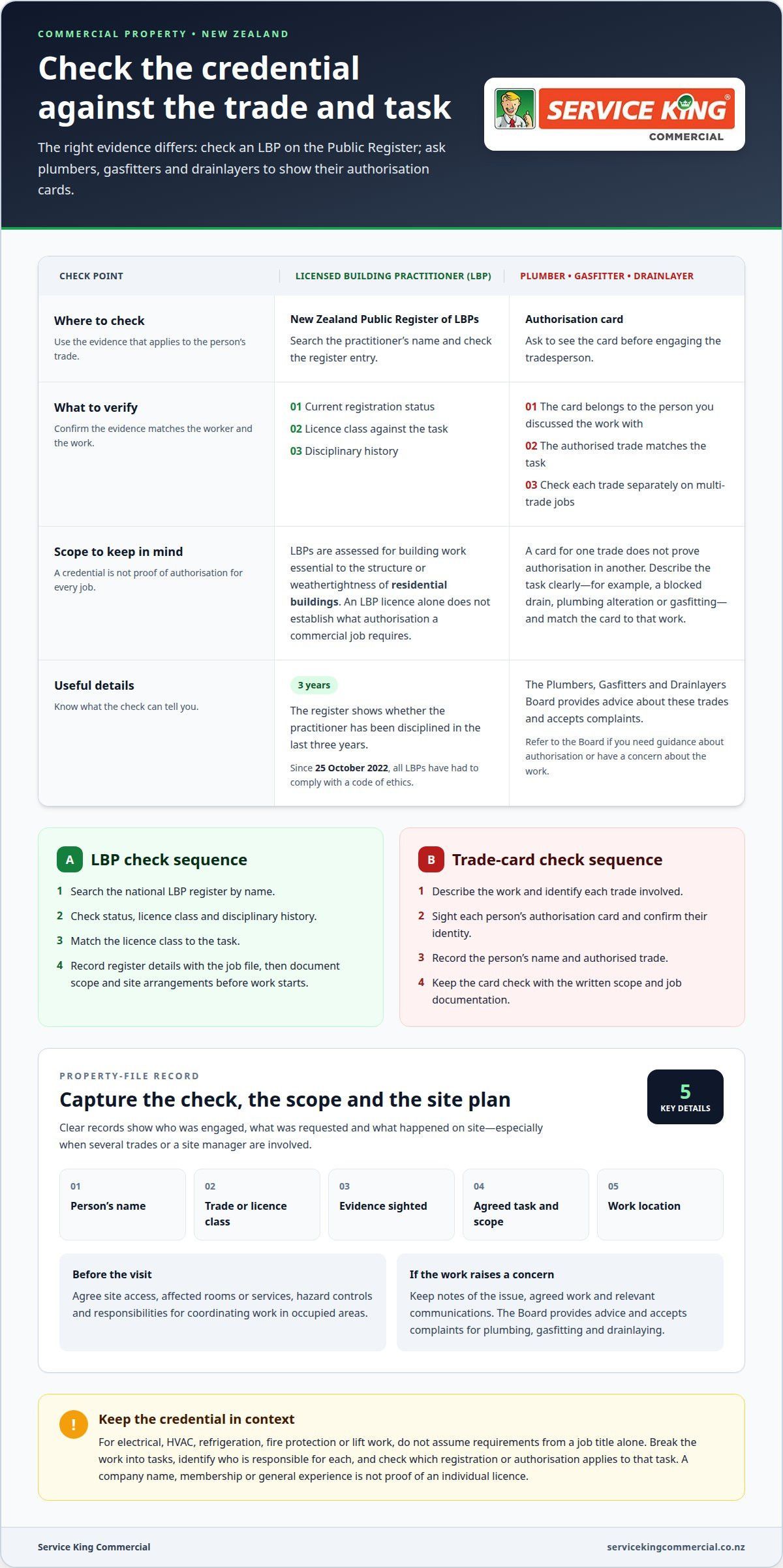
Start with the New Zealand Public Register of Licensed Building Practitioners (LBPs). Search the practitioner’s name and check their current status, licence class and disciplinary history. The register shows whether they have been disciplined in the last three years. MBIE licenses LBPs, who are assessed for building work essential to the structure or weathertightness of residential buildings. An LBP licence alone does not establish what authorisation a commercial job requires.
Since 25 October 2022, all LBPs have had to comply with a code of ethics. Match the person’s licence class to the task, then record the register details with the job file. Treat a title or business membership as separate from checking the individual’s registration.
For residential work, an LBP who belongs to the Registered Master Builders Association can offer a 10-year Master Build Guarantee. The association assesses members on building experience, qualifications, practical management experience, workmanship and financial responsibility. Consumers using a Registered Master Builder can also access the association’s independent complaints process. These protections relate to residential work; don’t assume they apply to commercial projects.
Regional checks depend on the property and work. LBP registration is checked through the national register, while commercial buildings constructed before 1976 may be assessed under the relevant council’s earthquake-prone buildings policy. For seismic status, identify the property’s council and check its applicable policy.
Before hiring, ask for current insurance evidence and check that its scope fits the work. Agree on site access, hazard controls and responsibilities for coordinating work in occupied areas.
Call-out fees and hourly rates vary according to the trade, travel, access, urgency and job scope. Request a written estimate that separates attendance, labour and materials where applicable.
Use this sequence: search the LBP register, match the licence class to the task, review the practitioner’s history, then document the agreed scope and site arrangements before work starts.
2. Checking plumbers, gasfitters and drainlayers
For plumbing, gasfitting or drainlaying, ask the tradesperson to show their authorisation card before engaging them. Check that the person presenting the card is the person you have discussed the work with. Record their name and authorised trade in your property files. If the job involves more than one trade, check each person’s authorisation separately.
Describe the task clearly before using a card as part of your hiring checks. For example, specify whether the work involves a blocked drain, a plumbing alteration or specialised gasfitting. When outlining detailed work such as flue and gas safety inspections, consulting technical service scopes from specialists such as pspgasengineering.com can help you define the exact job requirements. Keep the written scope with your record of the card check. This makes it easier to identify who is responsible for each part of a multi-trade job.
The Plumbers, Gasfitters and Drainlayers Board provides advice about these trades in New Zealand and accepts complaints. Refer to the Board for guidance if you need help understanding a trade’s authorisation or have a concern about the work. Keep notes of the issue, agreed work and relevant communications. Clear records show what was requested and what happened on site.
For commercial premises, coordinate access and the work area before the visit. Tell the tradesperson which rooms or services may be affected, and outline any site procedures they need to follow. If plumbing, gasfitting and drainlaying tasks are arranged together, record the scope and responsible person for each. This helps clarify who is attending and what work has been agreed.
Before work starts, use a simple record: the person’s name, trade, card sighting, agreed scope and work location. Keep it with the job documentation, especially when a site manager or property owner arranged the work. For wider property repair needs alongside trade work, commercial property maintenance can help keep building tasks organised.
3. Which trades in New Zealand must be licensed or registered to work on commercial properties?
Start with the task, not the building’s commercial label. Checks vary according to the trade and work involved. Plumbers, gasfitters and drainlayers, for example, should show their authorisation card before engagement. The Plumbers, Gasfitters and Drainlayers Board provides advice about these trades and accepts complaints. Check each person’s authorisation against the trade they will carry out. A card for one trade does not prove authorisation in another.
Licensed Building Practitioners are a separate category. Their assessment covers building work essential to the structure or weathertightness of residential buildings. This does not mean every person carrying out commercial building work needs an LBP licence, or that LBP registration covers every commercial task. Identify the work first, then check whether the relevant registration or authorisation applies to that person and task.
For other work, such as electrical, HVAC, refrigeration, fire protection or lift maintenance, don’t assume a licence requirement based on a job title alone. Break the work into tasks and identify who is responsible for each. Ask which registration or authorisation applies to the task, then assess the evidence against the agreed scope. This keeps an installer’s credentials distinct from a technician’s or inspector’s role.
A practical property file can record the trade, task, worker’s name, evidence sighted and agreed scope. For a job combining plumbing and drainlaying, for example, note who is doing each part and check both trades separately. Keep these records with the work order and site documentation. This clarifies the basis for engaging each person, without treating a contractor’s membership, company name or general experience as proof of an individual licence.
In short, confirm credentials for each task. Clear examples include LBPs for their assessed residential work and authorised plumbers, gasfitters and drainlayers for their respective trades. For other commercial work, identify the task and role to determine which credential applies.
4. Do commercial HVAC, refrigeration, fire protection, or lift contractors need specific NZ licences?
The answer depends on the work, not just the contractor’s trade label. HVAC may involve equipment servicing, electrical connections or refrigeration components. Fire protection can cover different systems and tasks. Lift work may involve maintenance, repair or inspection. These involve distinct responsibilities, so a company name alone won’t show who is qualified for each task.
Before engaging a contractor, divide the work into clear tasks. Ask who will complete each one, what relevant registration, authorisation or competency evidence applies, and who will supervise the work. For HVAC, distinguish mechanical servicing from any electrical work. For fire protection, identify the system and service. For a lift, separate maintenance from inspection or repair.
Match the evidence to the named worker and agreed scope. A company credential may not describe an individual technician’s role. Record names, credentials sighted, assigned tasks and any limits on the work. If subcontractors will attend, include their roles in the job record. This gives property managers a practical way to track responsibility across a multi-person job.
Set out the site arrangements too. Identify affected areas, access requirements, isolation points and any coordination needed with building operations. Agree how the contractor will report completed work and outstanding faults. For example, an HVAC service report should identify the equipment serviced and any recommended follow-up. Keep reports with maintenance records so future work can be scoped against the same asset information.
For licensed tradespeople on commercial property in NZ, the useful check is task-specific: identify the work, responsible person and evidence relevant to that role. Don’t treat HVAC, refrigeration, fire protection and lift work as one category. After specialist work is complete, prepare the site for handover with the areas ready for normal use.
Service King Commercial: Commercial Cleaning Services
After you’ve checked trade credentials and agreed the work scope, Service King Commercial can support ongoing property upkeep. Its Building Repair and Maintenance service addresses building repair and maintenance needs. Exterior Building Maintenance supports upkeep beyond the interior work area.
These services complement trade work; they do not replace the need to confirm a tradesperson’s authorisation for regulated tasks. Keep the contractor’s scope and records separate from wider maintenance work so responsibilities remain clear. For end-of-lease property requirements, Service King Commercial also provides an End of Lease Service.
Contact Service King Commercial to discuss building maintenance for your commercial property.
Plan the next stage of property upkeep
When a trade job is complete, keep the close-out notes with the property’s maintenance plan. Record the affected asset, work completed, unresolved issues and recommended follow-up. This gives site managers a useful reference when planning access or reviewing the same equipment later.
Keep job records, inspection notes and contractor reports in a consistent place. Note areas requiring access coordination, and share relevant site information with whoever manages the next work order. A clear process for licensed tradespeople working on commercial property in NZ helps owners brief incoming contractors consistently, especially when facilities responsibilities change.
Plan the next maintenance task around the building’s operational needs. Consider which spaces are affected, what information the incoming team needs and how the work fits with other scheduled activity. Good records make these decisions easier and help keep property care organised beyond a single repair, whether managing structural works or arranging exterior grounds contractors like Prime Tree Services for hedge trimming and pruning.
For support with commercial property upkeep, contact Service King Commercial to discuss your site’s needs. A practical next step keeps your maintenance plan moving forward.
Frequently Asked Questions
How can I verify a New Zealand tradesperson’s licence or registration?
Keep a dated record of the evidence reviewed and the work it relates to. Add the worker’s name, trade, project reference and any scope changes to the job file. If there is a concern about plumbing, gasfitting or drainlaying, preserve the agreed work details and relevant communications. This gives the Plumbers, Gasfitters and Drainlayers Board useful context if you make a complaint.
What building work on commercial property requires a licensed building practitioner?
There is no blanket LBP requirement for every commercial building task. Before procurement, record the property’s use, the building elements affected and the proposed work, such as an alteration to a wall or roof. Use that scope to determine whether LBP involvement is relevant, and note who is responsible for each part. A general maintenance label is not a complete description of the work.
How do licensing, compliance, and contractor requirements differ across NZ regions and councils?
Credential checks depend on the trade and task, not simply the region or commercial label. Check LBP status on the national register; for seismic status, identify the property’s council and check its applicable policy, as commercial buildings constructed before 1976 may be assessed under it.
Recent Posts