
October 21, 2026
Cleaning a warehouse floor shouldn’t bring dispatch to a halt. In Auckland, forklift and pallet traffic can spread dirt, tyre marks and debris across working areas, while cleaning at the wrong time can interrupt picking, storage and loading. A practical approach to warehouse floor maintenance Auckland starts with the floor’s condition, the type of debris and how each area is used.
How often to sweep, scrub or inspect depends on the warehouse. A busy loading zone may need a different routine from a quieter storage aisle. The goal is to keep working areas clean and serviceable, with tasks scheduled around operations rather than applied uniformly across the site.
This guide explains how to inspect warehouse floors, set a realistic maintenance cadence and choose upkeep methods for different conditions. It covers routine sweeping, planned scrubbing and targeted cleaning, as well as ways to schedule work around warehouse hours. It also explains how floor care can fit into a tailored commercial cleaning and scheduled maintenance programme in Auckland.
Key Takeaways
- Use visible wear and site activity to identify where floor upkeep needs attention first.
- Match sweeping, scrubbing and targeted cleaning to the debris or residue present, while considering surface suitability and access.
- Build a warehouse floor maintenance Auckland plan around mapped zones, recorded conditions and the work happening across the site.
- Coordinate maintenance windows with dispatch, pick-and-pack, freight arrivals and staff access to limit disruption.
- Set clear priority zones and upkeep goals to organise commercial cleaning and scheduled maintenance around your warehouse’s needs.
Table of Contents
- Warehouse floor maintenance in Auckland: what it protects
- How to assess warehouse floor condition before setting a plan
- Sweeping, scrubbing or targeted cleaning: compare floor-care methods
- Build a warehouse floor maintenance schedule around Auckland operations
- Arrange practical warehouse floor upkeep with Service King Commercial
Warehouse floor maintenance in Auckland: what it protects
Warehouse floor maintenance combines planned cleaning and inspection with timely action when the surface shows signs of deterioration. Keep routine debris removal separate from structural repair. Sweeping away loose strapping is a cleaning task. A crack, broken joint or uneven section needs to be recorded and assessed for repair, not simply cleaned over.
Forklift tyres, pallet movement and repeated turning put regular pressure on floors. Foot traffic adds dirt and fine debris, while loading activity can bring in residue from outside. Conditions vary across a site: a busy dock may collect more dirt and show more wear than a storage area with limited movement.
Warehouses in Auckland areas such as East Tāmaki, Penrose and Wiri operate in different buildings and conditions. Location alone doesn’t determine the right routine. Use the floor material, traffic patterns, work processes and observed condition to guide the plan. This is the practical basis of warehouse floor maintenance Auckland.
What warehouse floor maintenance covers
Separate routine cleaning, condition checks and repair follow-up. These tasks can sit in the same site plan, but each has a different purpose. General commercial floor cleaning methods include sweeping and scrubbing. Choose a method according to the floor and the type of soil present.
- Remove debris: Clear dust, pallet fragments and loose packaging from working areas.
- Inspect the surface: Note recurring residue, visible cracks, uneven patches, damaged joints or other changes in condition.
- Escalate deterioration: Record damage that may need building repair rather than treating it as a routine cleaning issue.
Plan by zone. Aisles need to remain clear for stock movement. Loading areas may collect more tracked-in dirt and residue, while storage zones can have different traffic and access patterns. The floor material matters too. Cleaning products and wet methods should suit the surface and follow relevant manufacturer guidance.
Why floor condition matters to warehouse operations
A clear, serviceable floor makes it easier to move people, stock and equipment through the building. Dust and loose debris can reappear along forklift routes or aisle edges if the source and pattern are overlooked. Residue around loading points may need focused attention rather than being treated as general floor dirt.
Record surface damage separately. A crack or uneven area may affect how equipment moves over that section and could worsen if overlooked. Note where it appears, whether it is changing and which operations use the area. This gives site managers a clearer basis for deciding what needs routine attention and what should be referred for repair.
Review the floor as part of normal site upkeep. A plan based on actual use helps organise cleaning and repairs around operational needs, rather than applying the same task and frequency to every part of the warehouse.
How to assess warehouse floor condition before setting a plan
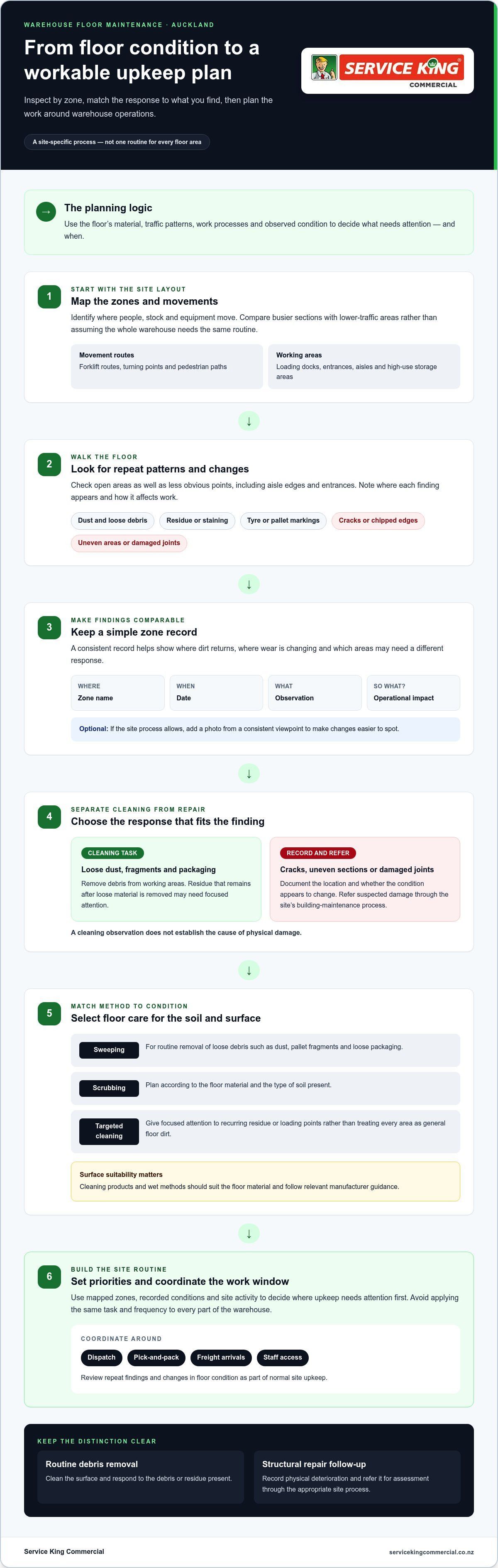
Inspect the floor before choosing a cleaning frequency. A consistent inspection shows where dirt returns, where wear is changing and which areas need a different response. This grounds the plan in observed conditions instead of applying the same routine across the whole warehouse.
Walk the site and note visible dust, loose debris, residue, tyre or pallet markings, cracks and uneven areas. Include open floor space and less obvious points such as aisle edges and entrances. Record each finding by location, how often it appears and its effect on work. For example, a recurring mark at a turning point may need a different response from occasional dust in a low-use storage bay.
Which warehouse zones need closer attention
Map forklift routes, turning points, loading docks, pedestrian paths, entrances and high-use storage areas. Compare these with lower-traffic sections. A warehouse in East Tāmaki, Highbrook or Penrose has its own traffic layout, so use the site’s actual movements and floor condition to set priorities rather than relying on location alone.
- Forklift routes and turning points: Look for recurring marks, concentrated debris and changes in the surface.
- Loading areas and entrances: Note tracked-in material, residue and repeat cleaning needs.
- Aisle edges and storage zones: Check whether debris gathers along boundaries or beneath areas that are less frequently accessed.
- Pedestrian paths: Record visible contamination or surface changes where staff regularly move.
Keep the record simple. A zone name, date, observation and operational impact are enough to compare conditions over time. Add a photo if your site process allows it, using a consistent viewpoint so changes are easier to spot.
How to distinguish surface dirt from damage
Loose dust and fragments are visible debris. Residue or staining may remain after loose material is removed. Markings can follow tyre or pallet movement, while worn-looking patches, cracks, chipped edges or uneven sections are physical changes to document. These observations help separate a cleaning task from a possible repair issue, but they don’t establish the cause of damage.
Track repeat findings rather than trying to diagnose them. Note whether a mark returns after cleaning, whether a crack appears to change and whether equipment or staff activity is affected. Refer suspected damage through the site’s established building-maintenance process. For planning cleaning tasks, the UK Health and Safety Executive’s floor cleaning risk management guidance offers background on managing cleaning-related risks. It is UK guidance, not New Zealand regulatory advice.
Use inspection records to shape warehouse floor maintenance Auckland around the site’s actual conditions. Service King Commercial’s commercial cleaning and scheduled maintenance can form part of a tailored approach to recurring property upkeep.
Sweeping, scrubbing or targeted cleaning: compare floor-care methods
Choose a cleaning method according to what is on the floor, where it has collected and how the area is used. Loose debris needs a different response from stuck-on residue. A mark or damaged patch may need further assessment rather than more cleaning. For warehouse floor maintenance Auckland, compare the task with the floor finish, site access and operational constraints before setting the routine.
| Method | Suitable task | Planning consideration | Limitation |
|---|---|---|---|
| Sweeping or dry cleaning | Removing loose dust, packaging fragments and other debris. | Consider traffic levels, debris volume and when the area can be accessed. | Doesn’t address stuck-on residue or physical floor damage. |
| Scrubbing or other wet cleaning | Addressing residue that remains after loose debris is removed. | Check surface suitability, product guidance, access and sequencing with warehouse work. | Introduces moisture and may be unsuitable for some surfaces or operating conditions. |
| Targeted spot cleaning | Responding to a localised mark, spill or residue patch. | Identify the affected area and consider nearby people, stock and equipment. | Doesn’t replace routine cleaning or resolve damaged and uneven flooring. |
When sweeping or dry cleaning may be suitable
Sweeping is suited to loose material that can be lifted from the floor, such as dust, pallet fragments or packaging debris. It can form part of routine care in aisles, storage areas and other working zones. Set the frequency according to site inspections. A route with steady forklift and pallet movement may collect debris faster than a section with little activity, so avoid assigning one interval to every zone by default.
Dry cleaning has limits. It won’t remove residue that has adhered to the surface, and it doesn’t address cracks, uneven areas or other physical defects. If debris returns quickly in one location, note the pattern and consider whether the task, timing or traffic in that zone needs a separate plan.
When scrubbing or targeted attention may be appropriate
Stuck-on residue may need a different approach from loose dust. Wet cleaning or localised attention can be considered, but the floor finish and the product manufacturer’s instructions should guide method selection. Plan how moisture will be managed and arrange the work so access, people, stock and equipment are accounted for. Don’t assume a method or cleaning product suits every warehouse floor.
Separate cleaning from repair. A mark may call for targeted cleaning, while a crack, chipped area or uneven section should be recorded and handled through the site’s building-maintenance process. Cleaning alone won’t correct a physical defect. Keep recurring cleaning tasks within a planned commercial cleaning programme, and make repair follow-up a distinct part of site upkeep.
Build a warehouse floor maintenance schedule around Auckland operations
A useful schedule links each task to a location, a reason and a suitable work window. Base it on observed floor condition and warehouse activity, not a fixed routine copied from another site. For warehouse floor maintenance Auckland, review the plan when traffic, debris levels or the way an area is used changes.
Build the schedule in a clear sequence:
- Map the zones. Mark forklift routes, loading areas, pedestrian paths, entrances and storage sections.
- Record the condition. Note recurring debris, residue, markings or surface changes by location.
- Match tasks to need. Assign routine cleaning, targeted attention or maintenance follow-up according to what the inspection shows.
- Set practical work windows. Fit tasks around dispatch, pick-and-pack, freight arrivals and staff access.
- Review and adjust. Check what was completed and whether the condition or operating pattern has changed.
Cleaning and other property tasks can also be coordinated within a broader upkeep plan. For example, warehouse access routes and external areas may need to be considered together when organising Auckland commercial exterior building maintenance.
Set maintenance frequency by activity and condition
Use traffic volume, debris type, visible build-up and operational priorities to decide how often each zone needs attention. A frequently used route may need more regular checks than a storage section with limited movement. Treat proposed intervals as starting points, not universal rules. The inspection record should show whether the chosen timing is working.
Write down the reason for each task. For example, note that a particular area is included because debris repeatedly accumulates there, or because its use has increased. This makes the schedule easier to explain and update when site activity changes. Reassess after a layout change, a shift in freight patterns or a recurring issue that remains after routine cleaning.
Plan work to limit disruption
Before scheduling a task, identify quieter periods, access routes and any areas that need temporary exclusion. Coordinate the work with dispatch and pick-and-pack so staff aren’t sent through an active work zone. For wet cleaning, plan around surface suitability, moisture management and the time needed before normal access resumes. Follow relevant product and floor-manufacturer instructions.
Agree which area is being worked on and what needs to be moved or kept clear. After each service, make a short record of missed areas, repeat residue, access problems and any changed needs. Use that review to shape the next schedule instead of leaving the same plan unchanged.
Service King Commercial provides commercial cleaning and scheduled maintenance in Auckland. These services can help organise recurring property needs around priority zones and operating constraints.
Arrange practical warehouse floor upkeep with Service King Commercial
A workable upkeep plan starts with clear site information. Identify the areas that collect debris or show recurring residue, note visible surface concerns and explain how cleaning can fit around warehouse activity. These details help shape a practical approach to warehouse floor maintenance Auckland , without applying the same routine to every part of the site.
Service King Commercial provides commercial cleaning and scheduled maintenance in Auckland. Planned cleaning can sit within a broader property programme, alongside other building needs. Set clear priorities and a realistic cadence around the site rather than assuming one method or frequency suits every floor.
What to include in a warehouse maintenance brief
Prepare a short brief before arranging work. Include the site location, floor areas, operating hours and zones that need priority. Describe recurring debris, visible condition issues and access constraints, such as busy loading points or routes that must stay available for staff and equipment. Note the service cadence you have in mind and how work should fit around daily operations.
Useful details include:
- Priority zones: Identify the aisles, entrances, loading areas or routes that need attention first.
- Observed conditions: Describe what appears, where it occurs and whether it returns after cleaning.
- Operating constraints: Set out dispatch patterns, pick-and-pack activity, freight arrivals and staff access needs.
- Maintenance goals: State what you want the programme to address and how often you expect it to be reviewed.
Keep cleaning observations separate from repair concerns. A recurring mark or debris build-up can inform cleaning plans. Cracks, uneven areas or other physical defects should be recorded as building-maintenance issues, not treated as cleaning tasks.
Coordinate floor upkeep with wider property maintenance
Planned cleaning can be organised alongside scheduled commercial property maintenance, with separate tasks and follow-up for floor defects. This gives site managers a clearer view of recurring upkeep and repair needs. Where related building work forms part of the same plan, commercial trade services in Auckland can sit within the wider maintenance discussion.
Keep the plan practical. Agree priority areas, the intended cadence and the operating constraints that shape access. Review the arrangement as warehouse use or observed floor conditions change. Service King Commercial can organise commercial cleaning and scheduled maintenance around your site’s needs. Discuss your warehouse maintenance requirements to outline the areas and operating needs you want the programme to address.
Make your warehouse upkeep plan work over time
A floor plan should remain useful as the warehouse changes. Treat it as a working document, not a one-off decision. Review it after layout changes, shifts in freight activity or recurring floor issues. This gives your team a clear way to update priorities and keep maintenance aligned with the way the site operates.
Set a review date and identify who will record changes. Keep notes on which tasks are being completed, where concerns persist and whether access arrangements still fit. These records can help make future decisions more consistent and keep warehouse floor maintenance Auckland focused on your site’s current needs.
Service King Commercial supports Auckland businesses with commercial property upkeep, including cleaning, scheduled maintenance and building repairs. A clear account of your priorities and operating requirements is a practical starting point for planning warehouse upkeep.
Discuss your Auckland warehouse maintenance needs. Set out your priority areas and operating requirements to start planning a suitable programme.
Frequently Asked Questions
What causes concrete floors in warehouses to become dusty?
Concrete floors can become dusty as the surface wears and fine particles loosen through repeated use. Forklift movement, pallet handling and general foot traffic may contribute, particularly in heavily used areas. Dust can also come from material brought into the building. Track where it returns and whether the surface looks worn or damaged. If dusting persists despite routine cleaning, record the area and raise it through the site’s maintenance process.
Can forklift traffic damage a warehouse floor?
Yes. Repeated wheel movement, turning and impacts from materials handling can contribute to wear or damage, especially on busy routes, at junctions and near loading points. Look for changes such as chipped edges, cracks or uneven patches. Note where these appear and whether equipment movement is affected. Regular cleaning won’t repair physical damage, so record concerns and refer them through your established building-maintenance process.
Are floor coatings suitable for every warehouse?
No. A coating’s suitability depends on the existing surface, its condition and how the area is used. A product intended for one floor or operating environment may not suit another. Before considering a coating, identify the floor material and check the manufacturer’s instructions for preparation, application and ongoing care. For warehouse floor maintenance Auckland, avoid treating a coating as a universal fix for dust, wear or surface damage.
Can warehouse floor cleaning remove tyre marks?
Cleaning may reduce or remove some tyre marks, but the result depends on the mark, floor finish and suitable cleaning approach. Older or ingrained marks may not respond like fresh surface residue. Don’t assume a stronger product or more aggressive method is appropriate. Check the floor manufacturer’s guidance and record any marks that remain or quickly return. If the surface itself appears damaged, treat that as a maintenance concern rather than a cleaning issue.
What should a warehouse floor maintenance record include?
Include the inspection or service date, the zone checked, observed conditions and any work completed. Record repeat issues, such as dust that returns near a particular route, and note whether they affected access or daily tasks. Add the person responsible for follow-up and a review date where needed. Consistent entries help site teams compare changes over time and distinguish a recurring cleaning task from a repair concern.
How should staff prepare a warehouse before scheduled floor cleaning?
Confirm the work area and timing with the people responsible for warehouse operations. Move stock or equipment only where agreed, and keep required access routes clear. Tell staff which area is being cleaned and where to avoid entry during the work. Identify any delivery or dispatch activity that could conflict with access. Before cleaning starts, make sure the agreed area is ready and relevant site instructions are understood.
Recent Posts